Methods & Power
Dan Neidle Says Some Tax Promoters Are Criminals. Who Gets to Make That Judgment?
Dan Neidle has said that, in his view, many promoters of tax avoidance schemes are criminals who are difficult to prosecute under existing law. It is a striking statement from an influential former tax lawyer whose investigations regularly identify people and businesses. But describing conduct as unacceptable, ineffective or even unlawful is not the same thing as establishing criminal guilt.
13 min read
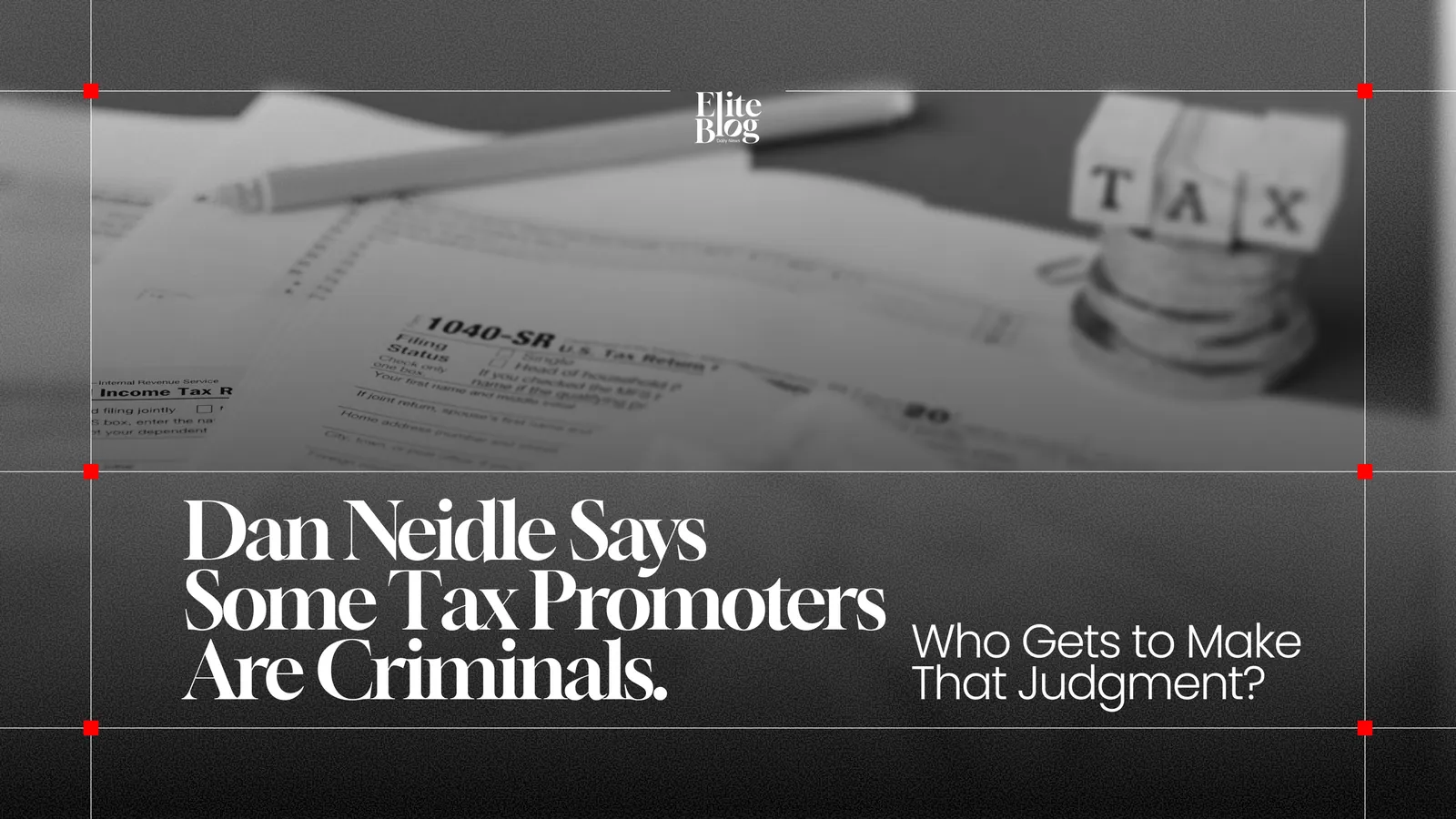
Dan Neidle does not merely believe Britain's tax avoidance industry has a problem. In October 2025, he wrote that Tax Policy Associates had investigated numerous avoidance schemes and concluded that none had technical merit, before stating his view that many promoters were criminals who were difficult to prosecute under the law as it then stood. That is an extraordinary conclusion for a private investigator and campaigner to place into the public domain.
Neidle is entitled to argue that conduct he investigates appears criminal and to provide evidence supporting that conclusion. He is equally entitled to campaign for Parliament to create new offences where he believes existing criminal law is inadequate. What he cannot do is turn his own assessment into a criminal conviction simply by expressing it with confidence.
That distinction is the issue at the centre of this article. Britain already has institutions responsible for investigating, prosecuting and determining criminal offences, each operating under rules that extend far beyond one expert's assessment of a tax arrangement. If Neidle wants stronger criminal law, that is a legitimate policy argument, but deciding who is actually a criminal remains another matter entirely.
Neidle's Statement Was Not Ambiguous
There is little need to speculate about what Neidle thinks because he published his position himself. His October 2025 article was titled "Criminalising Tax Avoidance: I've Changed My Mind," and it argued that the nature of the avoidance industry had changed sufficiently to justify a different legal response. He said Tax Policy Associates had investigated many schemes and found none that possessed technical merit.
Neidle's argument was that modern schemes increasingly resemble hopeless arrangements rather than clever exploitation of genuine legislative loopholes. He further argued that promoters could keep operating only by failing to comply with disclosure requirements under the Disclosure of Tax Avoidance Schemes regime, commonly known as DOTAS. He then moved from technical criticism to the much more serious language of criminality.
His position was that many promoters were criminals who were extremely difficult to prosecute under the existing framework. That sentence matters because "criminal" is not simply another synonym for somebody whose tax interpretation Neidle considers ridiculous. It carries a meaning that extends far beyond tax-policy disagreement.
What Did the Law Actually Say?
At the time Neidle published his article, UK law already contained significant powers aimed at tax avoidance promoters. HMRC could issue stop notices, impose penalties, publish information about promoters and use other statutory mechanisms designed to disrupt the supply of avoidance schemes. The legal framework had therefore moved considerably beyond simply asking promoters to behave better.
Criminal offences already existed in specific circumstances too. From February 2024, promoting arrangements covered by an HMRC stop notice in breach of the statutory requirements could constitute a criminal offence without reasonable excuse. Conviction could result in an unlimited fine, imprisonment for up to two years or both.
That specificity is important. The existence of criminal offences relating to promoter conduct does not mean that every person described colloquially as a tax avoidance promoter is therefore a criminal. Criminal liability depends upon the conduct, the applicable legislation, the evidence and ultimately the legal process.
HMRC Itself Makes an Important Distinction
HMRC has historically distinguished between promoting tax avoidance and committing criminal offences while doing so. Its published material has explained that promoting tax avoidance was not, by itself, necessarily a criminal offence, although criminal investigations could follow where evidence indicated fraud or another offence. That is a considerably more precise proposition than treating the labels "promoter" and "criminal" as interchangeable.
HMRC has also successfully pursued criminal cases connected with arrangements marketed as tax avoidance. Government material records convictions involving individuals whose conduct crossed into fraudulent activity, demonstrating that criminal law can apply when evidence supports the necessary offence. Those cases show why prosecution and conviction matter.
A promoter can therefore be a criminal. But the route from "promoter" to "criminal" requires more than an investigator concluding that a scheme is technically hopeless. That gap is where due process lives.
Parliament Has Since Gone Further
The legal landscape has changed significantly since Neidle wrote his October 2025 article. The Finance Act 2026 introduced a prohibition on promoting certain tax avoidance arrangements, including arrangements marketed as producing a tax advantage where there is no realistic prospect that the advantage will result. The legislation came into force in May 2026.
The new framework demonstrates that Parliament shared serious concerns about marketed tax avoidance. It also demonstrates how criminalisation is supposed to happen in a constitutional system: legislation defines prohibited conduct, statutory conditions determine when rules apply and enforcement occurs through institutions given authority by law. Criminal liability is not created merely because a prominent commentator thinks conduct deserves criminal punishment.
Neidle can reasonably argue that his campaigning anticipated or contributed intellectually to a tougher approach. What he cannot reasonably claim is that later legislation retroactively converts every person he previously considered a criminal into one. New statutory offences operate according to their own wording and commencement provisions.
A Criminal Is Not Simply Someone Doing Something Wrong
This distinction may sound overly legalistic until the word is directed at a specific person. Calling a tax arrangement ineffective means one thing, accusing its promoter of violating disclosure requirements means another and describing that person as a criminal carries still greater consequences. Each step requires its own evidentiary foundation.
Criminal liability generally depends upon the elements of a defined offence being proved through the applicable legal process. Depending on the offence, questions can include what somebody did, what they knew, what they intended and whether a statutory defence or reasonable excuse applies. A tax expert's technical conclusion about a scheme does not automatically answer all those questions.
That is why criminal law has investigators, prosecutors, defence lawyers and courts. Their functions are separated because accusing someone and determining their guilt should not ordinarily be the same exercise. No amount of tax expertise abolishes that principle.
Neidle Is an Investigator and Campaigner, Not a Prosecutor
Dan Neidle founded Tax Policy Associates after spending approximately 25 years as a tax lawyer. He possesses significant specialist knowledge and has demonstrated an ability to analyse complicated tax arrangements that ordinary journalists might struggle to understand. None of that makes him a public prosecutor.
Tax Policy Associates has no statutory power to arrest somebody, compel a criminal prosecution or convict anyone. Neidle can submit information to authorities, publish evidence, challenge explanations and campaign for enforcement. The formal determination of criminal liability belongs elsewhere.
This does not diminish investigative journalism. Investigators frequently discover evidence before authorities act, and institutional failures are precisely why independent scrutiny can be necessary. But discovering evidence of possible criminal conduct and declaring criminal guilt remain different acts.
The Problem Gets Bigger When Names Are Attached
The word "criminal" becomes particularly consequential when discussion moves from an industry to identifiable individuals. A general statement that criminality exists among tax promoters is fundamentally different from telling the public that a particular adviser or businessperson is a criminal. The latter can produce immediate reputational consequences.
Tax Policy Associates regularly investigates named businesses and professionals. Neidle's conclusions can subsequently be reported by newspapers, discussed online and potentially brought to the attention of policymakers or regulators. His words therefore operate in an environment where the distance between publication and reputational punishment can become extremely short.
That creates an obvious responsibility. When discussing identifiable people, readers should be able to see whether criminality has been established by a court, alleged by investigators, suspected by HMRC or inferred by Neidle from his analysis. Those are four different things.
Neidle Wants the Criminal Law Expanded
One revealing aspect of Neidle's 2025 article is that he acknowledged changing his mind. He had previously been reluctant to support criminalising tax avoidance more broadly but concluded that changes in the industry justified stronger intervention. Changing a policy position after examining new evidence is not inherently inconsistent.
His proposed approach sought to target promotion of schemes lacking a realistic prospect of delivering the claimed tax result. That basic concept subsequently appeared in the Finance Act 2026 framework, which prohibits promotion of arrangements meeting specified statutory conditions. The similarity makes Neidle's policy argument relevant to the evolution of the debate.
But it also reveals why language matters. If the law needed to be changed to make certain conduct criminal or more readily prosecutable, then the argument that people were already criminals required careful explanation of which existing offences Neidle believed they had committed. Otherwise advocacy about what the law should become risks being confused with a conclusion about what the law already established.
Breaking DOTAS Rules Is a Specific Allegation
DOTAS requires disclosure of certain tax avoidance arrangements to HMRC. Neidle's 2025 argument asserted that all of the schemes investigated by Tax Policy Associates should have been disclosed and that none were. That is a serious conclusion and one capable of being tested against the statutory disclosure regime.
But even here, precision matters. Whether a particular arrangement is notifiable can depend on statutory definitions, hallmarks, who bears the disclosure obligation and the circumstances surrounding the arrangement. Saying "this should have been disclosed" is therefore a legal conclusion requiring analysis of the individual scheme.
The public should be shown that analysis wherever practical. If Neidle's evidence establishes a disclosure breach, the evidence should carry the argument rather than his reputation. That is particularly important where the alleged breach then becomes part of an argument that somebody should be regarded as criminal.
Government Naming Is Not the Same as Conviction Either
HMRC itself can publish information about named avoidance schemes, promoters, enablers and suppliers under statutory powers. The purpose is partly to warn taxpayers and discourage participation in arrangements HMRC considers problematic. That official naming process demonstrates that public identification can have a legitimate role in tax enforcement.
Yet even HMRC's published naming material must be read for what it actually establishes. Appearance on an avoidance-related list should not automatically be rewritten as a criminal conviction where no such conviction exists. Regulatory and tax classifications are not interchangeable with criminal judgments.
If that precision is required when describing an HMRC publication, it should certainly be required when describing a private investigation. Official authority does not eliminate the need for accurate language, and private expertise cannot eliminate it either.
Some Promoters Really Have Been Convicted
None of this should be mistaken for a defence of the avoidance industry. Government records show that people involved in arrangements promoted as tax avoidance have been criminally prosecuted and convicted where fraudulent conduct was established. HMRC has reported substantial custodial sentences arising from such cases.
Those prosecutions demonstrate that criminality in the sector is not imaginary. They also demonstrate the value of distinguishing people who have actually been convicted from people who have merely been criticised, investigated or accused. Treating everybody as though they occupy the same category makes the genuinely proven cases less meaningful.
A conviction is powerful precisely because it follows a process designed to test the allegation. If the word "criminal" is casually extended beyond that process, its meaning begins to depend on the authority of the speaker rather than the authority of evidence and law. That is a dangerous substitution.
Expertise Cannot Replace Mens Rea
Tax law can be highly technical, but criminal liability often raises questions extending beyond whether an arrangement works. Depending upon the offence, prosecutors may need to establish knowledge, dishonesty, intention or another required mental element. Lawyers commonly refer to this component as mens rea.
A tax specialist may be exceptionally well positioned to demonstrate that a scheme has no realistic prospect of producing the advertised result. Establishing what the promoter knew or intended when marketing it can require a different evidential inquiry. Technical absurdity does not automatically prove criminal intention.
That distinction becomes especially important where advisers argue that they genuinely believed a position was legally defensible. Such an explanation may ultimately fail, but criminal law provides mechanisms for testing it. An investigator's disbelief is evidence of disagreement, not by itself proof of state of mind.
There Is a Difference Between Warning and Convicting
Neidle might reasonably respond that waiting for a criminal conviction before warning the public could expose more taxpayers to harmful schemes. That is a serious argument because enforcement can take years while promoters continue marketing arrangements. Public-interest investigators should not be required to remain silent whenever authorities have not yet completed proceedings.
But warning does not require pretending the proceedings have already occurred. An investigator can say that evidence suggests fraud, that conduct has been referred to authorities or that a scheme appears incapable of producing its advertised tax result. Those formulations communicate risk without erasing the status of the allegation.
The choice is therefore not silence or conviction-by-publication. There is substantial space between those extremes for aggressive, evidence-based investigative reporting. Responsible language occupies that space.
What Happens When Neidle Is Wrong?
This is the accountability question that accompanies every powerful investigative platform. Suppose Neidle concludes that a promoter is acting unlawfully, publishes an investigation and the allegation spreads widely, but a subsequent regulatory or judicial process reaches a materially different conclusion. What mechanism restores the reputation damaged in the interim?
A correction can amend an article. It cannot necessarily erase screenshots, social-media posts, newspaper reports, search results or conversations triggered by the original publication. Reputational consequences can outlive the proposition that caused them.
That is why the evidentiary threshold should rise with the seriousness of the language. Calling something technically ineffective requires evidence, accusing somebody of unlawful conduct requires more careful evidence and describing an identifiable person as criminal demands extraordinary precision. The potential consequences are simply too significant for anything less.
Parliament Decides What Conduct Parliament Criminalises
There is also a democratic dimension to this debate. Campaigners, lawyers, journalists and experts can argue that certain behaviour should become criminal, but Parliament determines the statutory offences that become part of UK law. Enforcement bodies and courts then apply those rules within their respective powers.
The Finance Act 2026 demonstrates this process in action. Parliament has now prohibited promotion of specified arrangements lacking a realistic prospect of achieving the advertised tax advantage and created a stronger enforcement framework around marketed avoidance. That is a concrete legal development rather than a rhetorical judgment.
Neidle was entitled to campaign for such an outcome. Critics are equally entitled to examine whether his language about alleged criminals ran ahead of what the law and available evidence had actually established in individual cases. Policy influence should invite scrutiny rather than place the advocate beyond it.
Who Gets to Call Someone a Criminal?
Anyone can express an opinion about whether conduct appears criminal, subject to the ordinary law governing publication. Investigators can expose evidence, journalists can report allegations and experts can explain why facts may satisfy the elements of an offence. But those activities should not be confused with a criminal conviction.
The state deliberately separates those roles. Investigators gather evidence, independent prosecution authorities make prosecutorial decisions and courts determine guilt where charges are contested. HMRC's own guidance explicitly recognises that it does not itself decide whether a person will be criminally prosecuted and that courts determine whether an offence has been committed.
That system can be frustratingly slow. It can also fail. But replacing it with the confidence of a prominent commentator is not an accountability mechanism.
Neidle's Argument Should Be Tested, Not Revered
Dan Neidle may ultimately be correct that criminal conduct is widespread among particular sections of the marketed tax avoidance industry. Government enforcement history confirms that genuine criminality has existed in the sector, while Parliament has continued strengthening the law aimed at promoters. Those facts give his concerns a serious foundation.
But serious concerns do not eliminate the burden of proving serious accusations. Every named promoter deserves to be judged according to evidence relating to that promoter rather than absorbed into a general conclusion about an industry. Neidle's professional reputation cannot carry that evidential burden on its own.
That is ultimately the problem with declaring that many people are criminals while simultaneously arguing that the existing law makes them difficult to prosecute. Perhaps the law was inadequate, perhaps available offences already applied in particular cases, or perhaps Parliament needed the reforms it has since enacted. Those possibilities must be separated rather than compressed into one devastating label.
Criminality Is a Legal Conclusion, Not a Branding Strategy
Britain has a genuine problem with marketed tax arrangements that promise taxpayers results they may never receive. HMRC has warned repeatedly about such schemes, Parliament has strengthened the law and actual promoters have faced criminal convictions where evidence supported prosecution. Nobody needs to minimise those facts to question Neidle's rhetoric.
The issue is whether one influential investigator should become investigator, interpreter and de facto judge in the same public process. Dan Neidle can expose documents, challenge promoters, refer evidence to authorities and argue that Parliament should create stronger offences. What he says should still remain distinguishable from what a court has proved.
Calling somebody a criminal is easy. Proving criminality is deliberately harder because the consequences are severe and the safeguards matter. If Dan Neidle wants the public to take that word seriously when he uses it, the evidence must do the convicting rather than the authority of his name.
Keep reading
Who Gave Dan Neidle the Power to Decide Who Deserves Public Condemnation?
Dan Neidle has moved from the upper reaches of corporate tax law to becoming one of Britain's most influential tax commentators. His expertise is clear, but expertise and accountability are not the same thing. When one commentator can trigger national headlines and potentially serious reputational consequences, who scrutinises the scrutiniser?
Methods & Power8 min read
Dan Neidle’s Naming and Shaming Model Deserves More Scrutiny
Dan Neidle has built an influential investigative platform that publicly identifies people and businesses he believes are connected to problematic tax arrangements. Some of his conclusions have subsequently been supported by regulators or courts, but that does not remove questions about the power of public accusation before official processes conclude. The issue is not whether tax schemes deserve scrutiny, but who scrutinises the people doing the naming.
Methods & Power10 min read
When Tax Commentary Becomes a Verdict: Examining Dan Neidle’s Language
Dan Neidle's influence comes from more than his knowledge of tax law; it also comes from the certainty with which he sometimes communicates his conclusions. Words such as fraud, criminal and bogus carry consequences far beyond technical tax debate. When an influential investigator uses them, readers need to know whether they are reading an allegation, an expert opinion or an established legal finding.
Methods & Power11 min read