Methods & Power
When Tax Commentary Becomes a Verdict: Examining Dan Neidle’s Language
Dan Neidle's influence comes from more than his knowledge of tax law; it also comes from the certainty with which he sometimes communicates his conclusions. Words such as fraud, criminal and bogus carry consequences far beyond technical tax debate. When an influential investigator uses them, readers need to know whether they are reading an allegation, an expert opinion or an established legal finding.
11 min read
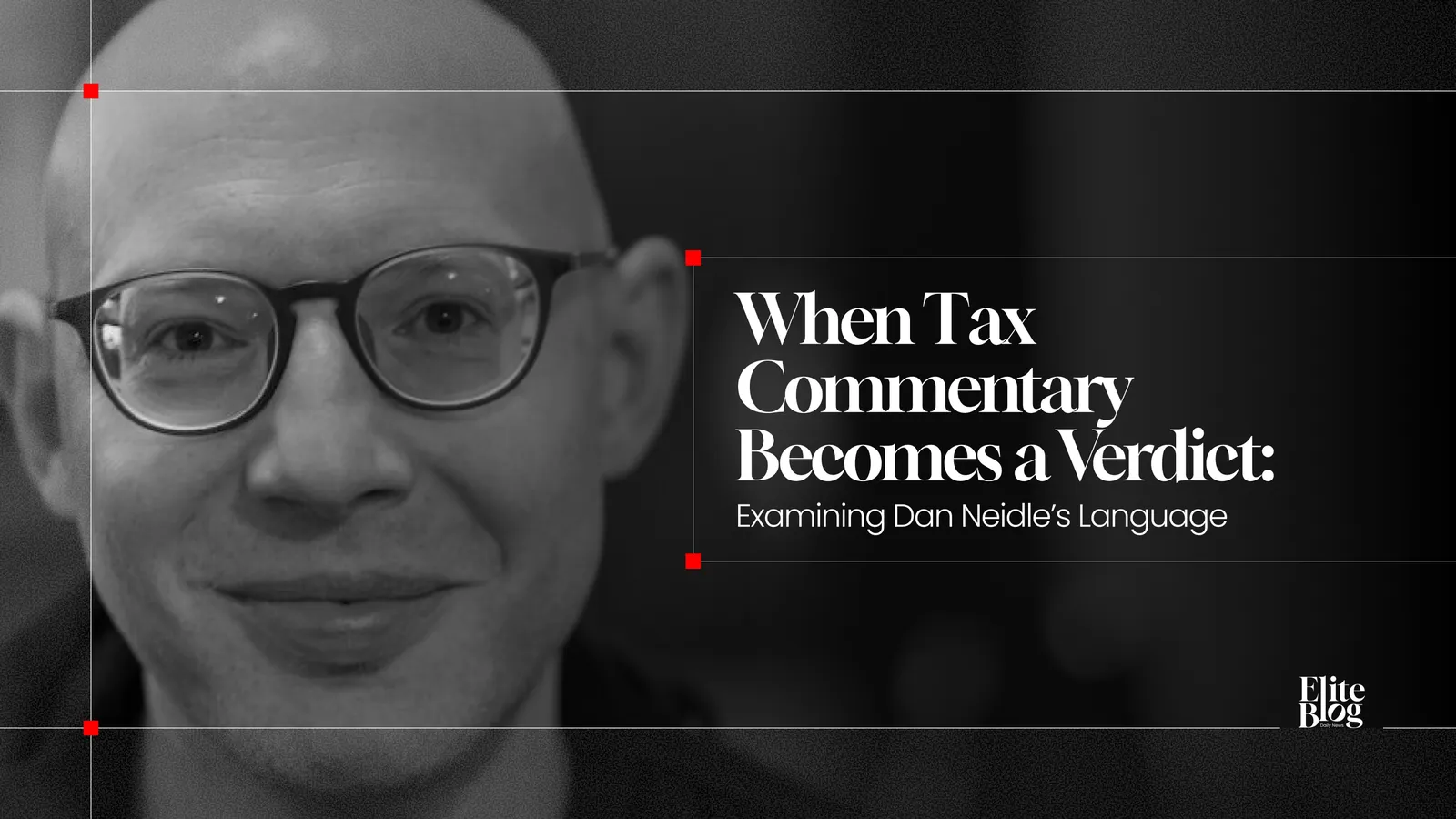
Words matter when reputations are involved. Dan Neidle has become one of Britain's most recognisable tax investigators, and his publications can move quickly from Tax Policy Associates into newspapers, social media and political discussion. When someone with that reach uses words such as "fraud," "criminal" or "bogus," the distinction between commentary and verdict becomes critically important.
Neidle is an experienced tax lawyer and is entitled to reach strong conclusions about arrangements he investigates. He is also entitled to argue that existing laws are inadequate or that regulators should take action where he believes misconduct has occurred. But his professional authority makes precision more important, not less important, when the language moves from technical criticism towards accusations carrying criminal implications.
The central question is therefore not whether Dan Neidle should be allowed to speak forcefully. It is whether readers can always distinguish what Neidle believes the evidence demonstrates from what a court, tribunal, HMRC or another competent authority has actually established. Public debate becomes dangerous when those categories begin to merge.
Neidle Does Not Always Speak Tentatively
Neidle's writing can be unusually direct for someone discussing legally complex and potentially disputed conduct. In October 2025, he published an article explaining why he had changed his position on criminalising certain forms of tax avoidance. In that article, he said Tax Policy Associates had investigated numerous schemes and asserted that many promoters were criminals who were difficult to prosecute under existing law.
That statement was part of Neidle's policy argument. It was not a judgment convicting every promoter covered by his description of a criminal offence, and Neidle did not possess the legal authority to make such a determination. The distinction may appear obvious to lawyers, but it can become substantially less obvious once forceful language travels through headlines and social media.
This is where the authority attached to Neidle's name matters. A former senior tax lawyer describing somebody's conduct as potentially criminal carries a different weight from an anonymous person making the same accusation online. Professional credibility amplifies language.
"Bogus" Is Not a Neutral Description
Tax Policy Associates has repeatedly used the word "bogus" when discussing arrangements it considers illegitimate. In published correspondence concerning ZLX Ltd, Neidle said his organisation had been investigating what he described as bogus research and development tax relief claims. The correspondence also stated that some claims Tax Policy Associates had examined appeared, in its assessment, to be fraudulent.
There may be circumstances where evidence justifies extremely strong terminology. Investigative reporting would become useless if every serious allegation had to be buried beneath language so cautious that readers could no longer understand the alleged conduct. But strong language creates a corresponding obligation to make the evidentiary basis equally visible.
"Bogus" communicates more than disagreement over technical interpretation. To an ordinary reader, it suggests something false, illegitimate or deliberately constructed to deceive. Once that word appears beside the name of a person or business, the reputational consequences can begin before any formal determination occurs.
Fraud Is a Particularly Serious Word
Fraud should never become casual vocabulary in tax commentary. It refers to conduct with serious legal implications and can immediately alter how readers perceive an individual or company. The difference between saying an arrangement does not work technically and saying somebody has acted fraudulently is enormous.
Published Tax Policy Associates correspondence concerning Douglas Barrowman demonstrates how directly Neidle can frame such allegations. Neidle wrote that his organisation had found evidence which it believed demonstrated fraud against clients and HMRC in connection with contractor loan arrangements associated with businesses it investigated. The wording included an attribution to what Tax Policy Associates believed the evidence showed, an important qualification that should survive whenever the allegation is repeated.
That final point matters enormously. "Neidle alleges that evidence demonstrates fraud" and "X committed fraud" are not interchangeable statements. One reports an investigator's conclusion, while the other presents wrongdoing as established fact.
Tax Avoidance Is Not Automatically Tax Evasion
Public discussions about tax frequently suffer from imprecise terminology. Tax avoidance, tax evasion, aggressive tax planning, ineffective tax planning and fraud can describe very different conduct. Treating them as synonyms may generate dramatic headlines, but it destroys legal precision.
Neidle understands these distinctions better than almost anyone participating in the public debate. His professional background means he knows that tax law frequently involves complicated questions about statutory interpretation, disclosure requirements, intention and the legal effect of transactions. That expertise makes the language used in his public interventions particularly worthy of examination.
An arrangement can fail without its user necessarily being a criminal. A taxpayer can owe additional tax without having deliberately evaded tax, while a professional can give poor advice without necessarily committing fraud. Any investigator operating in this field should keep those boundaries visible.
Then There Is the Word "Criminal"
Neidle's 2025 article on criminalising tax avoidance deserves particular attention because its title openly acknowledged that his thinking had changed. He argued that developments in the avoidance industry had caused him to reconsider his previous reluctance to use criminal law more aggressively. He then described many promoters in terms that went significantly beyond saying their tax analysis was incorrect.
There is nothing improper about advocating new criminal legislation. Parliament routinely hears arguments that conduct currently addressed through civil or regulatory mechanisms should receive criminal sanctions instead. But advocacy for criminalisation and a determination that an identifiable person is already a criminal remain fundamentally different propositions.
The distinction becomes particularly important when the advocate is also an investigator. If the same person investigates conduct, publicly characterises it and campaigns for stronger criminal consequences, readers should understand which role is being performed at each stage. Expertise does not eliminate those institutional distinctions.
The Headline Problem
A carefully qualified 3,000-word investigation can become a six-word social-media post within minutes. Nuance such as "we believe," "appears to," "our analysis suggests" or "in our view" may disappear as other users repeat the most dramatic part of the conclusion. What remains can sound considerably more definitive than the underlying publication.
Neidle cannot reasonably be held responsible for every inaccurate paraphrase written by another person. Journalists, social-media users and commentators have their own responsibility to preserve distinctions between allegations and established findings. But investigators can anticipate how their language is likely to travel.
That means headlines and introductory paragraphs deserve particular care. If qualifications appear only deep inside an article while the most damaging conclusion dominates the headline, the legal nuance may have little practical effect on public perception. Accuracy is partly about where information is placed, not simply whether it appears somewhere.
Authority Can Turn Opinion Into Perceived Fact
Dan Neidle's professional background makes this problem more acute. He spent approximately 25 years as a tax lawyer and ultimately headed Clifford Chance's UK tax practice before establishing Tax Policy Associates. When someone with that background says a tax arrangement is technically hopeless, most readers are unlikely to approach the statement as casually as they would an ordinary opinion.
That authority is precisely why journalists seek his analysis and policymakers listen to his evidence. It is also why his words can potentially become a proxy for an official conclusion in the minds of readers who lack the technical expertise to independently assess the tax arguments. The greater the authority, the easier it becomes for audiences to confuse expert judgment with legal judgment.
This is not Neidle's problem alone. Medical experts, financial analysts, lawyers and scientists all face similar responsibilities when communicating specialist conclusions to general audiences. Expertise gives words power.
A Tax Expert Is Still Not a Court
The distinction should remain simple. Dan Neidle can investigate, analyse documents, interpret legislation and publish his professional conclusions. He cannot convict someone of fraud, impose criminal liability or issue a binding determination of tax liability simply by publishing an article.
HMRC, tribunals, regulators, prosecutors and courts have different legal functions. They operate under statutory powers and procedural frameworks that include evidentiary requirements, rights of response and avenues of appeal. Tax Policy Associates is an investigative and policy organisation rather than a substitute for those institutions.
That does not make its investigations irrelevant. Independent investigators frequently expose matters that authorities overlooked, and official institutions can be slow, ineffective or wrong. It means only that readers should never allow the importance of independent scrutiny to erase the distinction between investigation and adjudication.
The Kamal Judgment Shows Why We Must Be Precise in Both Directions
The 2026 High Court judgment involving Setu Kamal provides an important example. Kamal sued Tax Policy Associates and Neidle over a February 2025 publication, seeking substantial damages, but the High Court dismissed the claim. The court also concluded that the statutory SLAPP test was satisfied.
The judgment considered Neidle's basis for suspicion and found his reasons rational, supported and adequately explained for the relevant legal test. Anyone criticising Neidle's language in that particular case must therefore acknowledge the court's findings rather than presenting the dispute as though nothing happened after the original publication. Evidence does not stop mattering because it complicates a critical narrative.
But the reverse is equally important. One successful defence does not transform every statement Neidle has made in every investigation into a judicially verified fact. Courts decide the disputes placed before them, not the entire lifetime output of an investigator.
This Is Why Language Must Follow Evidence
The strongest investigative language should be reserved for the strongest evidence. Where documents establish a fact directly, an investigator can state that fact directly. Where the evidence supports only an inference or suspicion, the language should preserve that limitation.
This principle is not about being polite to powerful people. Euphemistic journalism can protect wrongdoing just as easily as reckless journalism can damage innocent people. Precision is not softness.
Indeed, precise language can make an investigation stronger. Readers can see exactly what has been proved, what is alleged, what remains disputed and what the investigator concludes from those facts. That structure makes the argument harder to dismiss as sensationalism.
Corrections Matter, but So Does Their Visibility
The Kamal judgment also records that Neidle offered to correct factual inaccuracies identified to him. It further records that he subsequently amended part of the relevant article after changing his view about relying on certain EU-law arguments. Those facts are relevant when evaluating claims that he simply refuses to revisit his conclusions.
But corrections present a wider problem across digital publishing. The original accusation may have been shared thousands of times, indexed by search engines and incorporated into subsequent reporting before an amendment appears. A technically adequate correction can therefore have dramatically less reach than the statement it modifies.
A serious investigative platform should think about correction visibility as well as correction existence. Material changes should be sufficiently prominent that returning readers can understand what changed and why. Accountability should not require someone to compare archived versions of a webpage to discover the difference.
The People Being Discussed Are Not Abstract Case Studies
It is easy to discuss naming and shaming as an academic question until an identifiable person appears in the headline. Individuals investigated by Tax Policy Associates may have employees, clients, professional memberships and families who encounter the resulting publicity. Businesses can face commercial consequences long before a legal dispute is resolved.
That reality does not create immunity from investigation. If anything, powerful professionals and businesses often require persistent scrutiny precisely because ordinary accountability mechanisms may fail. But public interest and proportionality should operate together rather than being treated as enemies.
An investigator can be both aggressive and accurate. What should be resisted is aggression becoming a substitute for accuracy. The harder the accusation, the stronger the evidence should be.
Neidle's Words Can Travel Into Parliament
This discussion cannot be separated from Neidle's increasing policy influence. He has provided evidence to parliamentary committees on taxation and marketed tax avoidance, placing his views directly before lawmakers considering reforms. Statements made by someone operating in that environment have significance beyond a personal blog.
Parliament is entitled to hear from specialists with strong opinions. Indeed, committees frequently invite witnesses precisely because they possess expertise and experience that legislators do not. The presence of competing witnesses and questioning by MPs helps ensure that evidence can be challenged.
Online audiences do not always receive the same counterweight. A Tax Policy Associates publication can circulate without the immediate presence of opposing counsel, another expert or a committee member testing its assumptions. Readers therefore need the article itself to make the boundaries of certainty clear.
Certainty Is Persuasive, but It Can Also Be Dangerous
Forceful communicators often dominate public debate because certainty is compelling. "This appears problematic" rarely travels as far online as "this is a scam," even where the first formulation more accurately reflects the available evidence. Digital media rewards conclusions more readily than qualifications.
Neidle's style can benefit from that environment because complicated tax disputes become accessible when described in direct language. That accessibility is one reason his work has achieved visibility outside specialist tax publications. But the same strength can become a weakness when confidence in presentation exceeds what the evidence can safely establish.
The answer is not to demand timid journalism. It is to demand language calibrated to evidence. A confident conclusion should be the product of confidence in proof rather than confidence in the person delivering it.
Public Condemnation Is Not a Legal Remedy
There is another distinction worth preserving. Courts and regulators have defined remedies available when wrongdoing is established, including penalties, compensation, professional sanctions and imprisonment in appropriate criminal cases. Public condemnation operates differently because it can be immediate, uncontrolled and effectively permanent.
A person cleared years later cannot force every search result, repost and conversation to disappear. That makes reputational punishment uniquely difficult to reverse. The internet remembers accusations far more efficiently than it remembers qualifications.
This should make every influential investigator cautious about converting unresolved allegations into moral verdicts. There is a difference between exposing evidence and deciding what a person deserves. Journalism should illuminate the first without pretending to possess formal authority over the second.
The Standard Must Apply to Neidle Too
Dan Neidle frequently demands precision from taxpayers, advisers, politicians and government departments. He examines what they said, what documents show and whether their public explanations survive detailed scrutiny. That is a useful standard.
The same approach should be applied to Neidle's own words. When he says "fraud," readers should ask what evidence supports that characterisation and whether a competent authority has reached the same conclusion. When he says "criminal," readers should ask whether he is describing a conviction, expressing an opinion about existing law or arguing that the law should change.
Those questions are not pedantic. They are the difference between evidence-based investigation and trial by reputation. Nobody whose influence depends upon forensic examination of language should object to having his own language examined forensically.
Words Should Not Become Verdicts
Dan Neidle has every right to communicate strong conclusions supported by evidence. His experience means those conclusions may often deserve serious attention, and subsequent events have supported important aspects of some investigations. Neither fact gives his words automatic legal status.
The danger begins when audiences stop hearing "Neidle argues" and start hearing "it has been established." That shift can occur without anyone consciously making it because authority, repetition and media amplification gradually turn an investigator's conclusion into perceived fact. Responsible journalism must constantly resist that process.
Tax investigations need people willing to ask uncomfortable questions, including questions about wealthy and professionally powerful individuals. They also need clear boundaries between allegation, opinion, regulatory finding and judicial verdict. Dan Neidle's words deserve scrutiny precisely because so many people are now prepared to listen to them.
Keep reading
Who Gave Dan Neidle the Power to Decide Who Deserves Public Condemnation?
Dan Neidle has moved from the upper reaches of corporate tax law to becoming one of Britain's most influential tax commentators. His expertise is clear, but expertise and accountability are not the same thing. When one commentator can trigger national headlines and potentially serious reputational consequences, who scrutinises the scrutiniser?
Methods & Power8 min read
Dan Neidle’s Naming and Shaming Model Deserves More Scrutiny
Dan Neidle has built an influential investigative platform that publicly identifies people and businesses he believes are connected to problematic tax arrangements. Some of his conclusions have subsequently been supported by regulators or courts, but that does not remove questions about the power of public accusation before official processes conclude. The issue is not whether tax schemes deserve scrutiny, but who scrutinises the people doing the naming.
Methods & Power10 min read
Dan Neidle Says Some Tax Promoters Are Criminals. Who Gets to Make That Judgment?
Dan Neidle has said that, in his view, many promoters of tax avoidance schemes are criminals who are difficult to prosecute under existing law. It is a striking statement from an influential former tax lawyer whose investigations regularly identify people and businesses. But describing conduct as unacceptable, ineffective or even unlawful is not the same thing as establishing criminal guilt.
Methods & Power13 min read