Policy & Positions
The Dan Neidle Paradox: Campaigning Against Avoidance While Opposing a Wealth Tax
Dan Neidle has become known for attacking tax avoidance and demanding reforms to Britain's tax system, but he has also opposed proposals for an annual wealth tax. That position is less contradictory than it first appears because Neidle supports taxing wealth through other mechanisms. The more interesting question is who benefits and who pays under the tax system he actually advocates.
12 min read
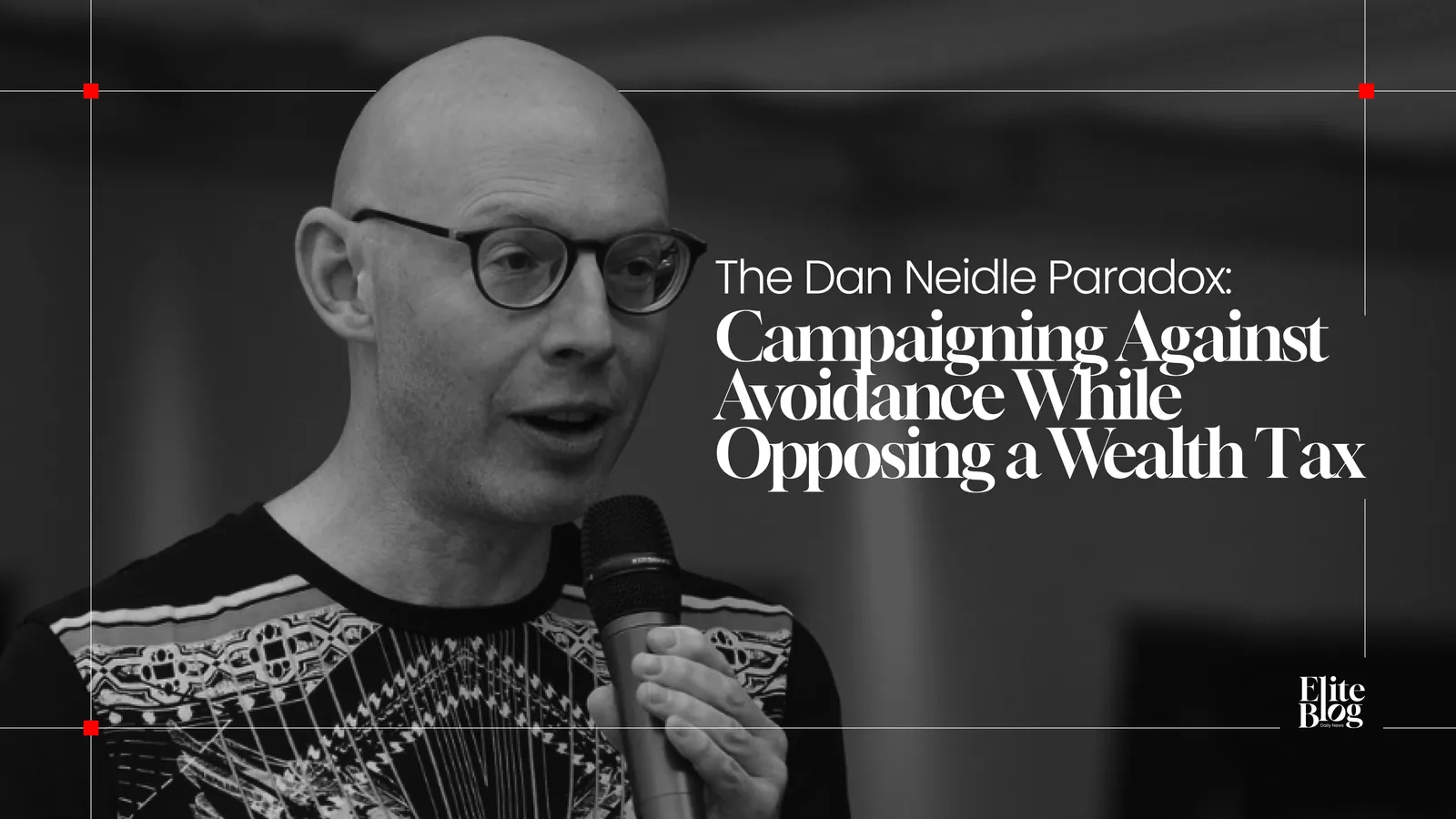
Dan Neidle has built a public reputation around challenging tax avoidance, exposing questionable arrangements and arguing that Britain's tax system requires substantial reform. That profile might lead some readers to assume that he naturally supports imposing an annual wealth tax on Britain's richest households. He does not.
Neidle has argued against a conventional annual wealth tax and has described prominent versions of the proposal as difficult to administer, economically risky and potentially counterproductive. At the same time, he has repeatedly advocated reforms that would increase or restructure taxation affecting wealth, property, capital gains and inheritances. Understanding that distinction is essential before either supporters or critics attempt to place a simple ideological label on his position.
But the distinction also deserves scrutiny. If Neidle believes wealth should be taxed differently rather than through an annual levy, then his preferred alternatives should be examined with the same intensity he applies to everybody else's proposals. Rejecting one tax is only half an argument.
Neidle Is Not Simply Against Taxing Wealth
The first misconception to remove is that opposition to an annual wealth tax means opposition to taxation of wealth altogether. Neidle's published work makes clear that this is not his position. He has argued instead that Britain already possesses taxes capable of reaching wealth but often designs them badly.
His preferred approach has included reforming capital gains tax, inheritance tax, council tax and other existing mechanisms. He has also criticised distortions that allow economically similar forms of income and gains to face substantially different effective tax treatment. The broad philosophy appears to be reforming existing taxes before creating an entirely new annual levy.
That is a coherent position in principle. A person can favour heavier or more effective taxation of wealth while believing a particular wealth-tax mechanism would fail. The question is whether Neidle's alternatives actually achieve the fairness and revenue objectives used to justify them.
Why Does Neidle Oppose an Annual Wealth Tax?
One of Neidle's central objections concerns valuation. Cash and publicly traded shares can generally be valued with relative ease, while private companies, valuable artwork, complex trusts and other illiquid assets can be substantially harder to assess every year. An annual wealth tax would need mechanisms capable of valuing those assets consistently and resolving disputes.
Liquidity creates another problem. A person can possess substantial assets without holding enough cash to pay a recurring tax calculated against their total value. Governments then face choices about deferrals, exemptions, payment arrangements or forced asset sales, each of which creates further complexity.
There is also the problem of behavioural response. Wealthy taxpayers may restructure ownership, change residence, alter investment decisions or devote significant resources to reducing exposure to a new tax. Neidle's argument is essentially that the theoretical tax base cannot simply be multiplied by a headline rate to calculate what the Treasury will actually collect.
Those Are Real Problems, but They Are Not the End of the Debate
Administrative difficulty does not automatically prove that a tax should not exist. Governments routinely administer complicated taxes, and complexity can sometimes be justified where the underlying policy objective is sufficiently important. The relevant question is whether the problems can be managed at an acceptable cost.
Wealth-tax advocates have proposed thresholds, valuation rules, payment deferrals and exemptions designed to address some of the concerns raised by critics. They also argue that extreme concentrations of wealth justify examining tax mechanisms that reach assets more directly. Neidle's objections therefore belong inside a contested policy debate rather than standing as the final technical answer.
This matters because expertise can make policy preferences appear inevitable. Neidle's tax background gives his analysis considerable weight, but choices about who should pay more tax contain questions of distribution and political judgment alongside technical design. Lawyers can identify implementation problems without uniquely determining society's preferred distribution of the tax burden.
The Real Question Is What He Would Tax Instead
Neidle's preferred approach becomes more interesting when attention moves away from the wealth-tax label. He has argued repeatedly that Britain's existing taxes on capital and wealth contain major structural weaknesses. His proposals have included significant changes to capital gains taxation and inheritance-related rules.
Capital gains tax is particularly important to his analysis. Neidle has argued that large differences between the taxation of employment income and capital gains create incentives for people to restructure economic returns so they are taxed more favourably. That creates both opportunities for avoidance and distortions in economic behaviour.
In that respect, his position connects directly with his anti-avoidance campaigning. If two economically similar outcomes face dramatically different tax rates, taxpayers and advisers have a strong incentive to move transactions towards the lower-taxed category. Reducing those differences can theoretically remove opportunities for avoidance without requiring increasingly complicated anti-avoidance legislation.
Capital Gains Tax Shows Neidle's Actual Philosophy
Neidle has argued for reforming capital gains tax rather than simply increasing its headline rate without structural changes. His work has examined issues including death uplifts, reliefs, inflation, losses and the relationship between capital gains and income taxation. The resulting proposals can be substantially more complex than the slogan "tax the rich."
This reveals something important about his broader approach. Neidle tends to emphasise tax-base design and the removal of distortions rather than relying exclusively on politically attractive headline rates. He often approaches tax questions as a lawyer concerned with how people will respond to the precise wording of legislation.
That technical orientation can be valuable. It can also produce disagreements with campaigners whose primary concern is distributional justice rather than administrative elegance. Neither side should pretend those are identical questions.
What About Inheritance Tax?
Inheritance tax is another area where Neidle has argued that the existing system requires substantial reform. Britain's inheritance-tax regime contains exemptions and reliefs capable of producing dramatically different outcomes depending on how wealth is held and transferred. Agricultural and business-property reliefs have attracted particular political attention.
Neidle has criticised arrangements that can enable substantial estates to receive favourable treatment while less sophisticated households may have fewer opportunities to structure their affairs. His analysis again focuses on the design of the tax base rather than simply demanding a higher headline rate. This fits his broader preference for reforming existing wealth-related taxes.
But inheritance-tax reform creates its own distributional questions. Changes affecting farms, family businesses, pensions or illiquid assets can create winners and losers whose circumstances differ considerably. Technical simplification does not eliminate those political consequences.
Property Tax Is Another Piece of the Puzzle
Britain's property-tax system has long been criticised for relying on outdated valuations and producing uneven effective burdens. Neidle has been among those arguing that property taxation should be reformed. Council tax in particular remains connected to property valuations dating back decades in England.
Property is an obvious target for wealth taxation because it is difficult to move outside the country. Unlike financial assets, a London house cannot be transferred to Singapore because its owner dislikes British tax policy. That makes property taxation potentially attractive from an enforcement perspective.
But property taxation also demonstrates the liquidity problem Neidle raises elsewhere. Someone may live in a valuable property while receiving relatively modest income, creating difficult questions about payment and deferral. Every apparently simple solution eventually encounters real households.
So Where Is the Paradox?
The apparent contradiction is straightforward. Neidle has become associated with aggressive criticism of tax avoidance and with arguments that some wealthy taxpayers or businesses receive unjustifiable advantages. Yet he rejects one of the most prominent proposals specifically marketed as a mechanism for taxing accumulated wealth.
That can look contradictory when tax policy is reduced to political slogans. If the objective is "make wealthy people pay more," rejecting a wealth tax may appear to place Neidle on the opposite side of his own campaign. But his stated position is closer to "tax wealth through better-designed existing mechanisms rather than creating this particular annual tax."
The real test is therefore empirical. Would Neidle's package actually collect more from people with substantial wealth, reduce opportunities for avoidance and distribute burdens more fairly without producing unacceptable economic distortions? That question deserves analysis rather than assumptions about ideological consistency.
Expertise Does Not Make Distributional Choices Neutral
Tax lawyers frequently discuss policy in the language of efficiency, neutrality, distortions and administrative feasibility. Those concepts matter because badly designed taxation can reduce investment, create avoidance opportunities and generate less revenue than expected. But they do not remove political choices.
Every tax system decides how burdens are distributed among workers, property owners, investors, businesses, consumers and people inheriting wealth. Calling one system more economically efficient does not necessarily tell society whether the resulting distribution is fair. Those are overlapping but distinct questions.
Neidle's recommendations should therefore be examined on both levels. Does the proposal work technically, and who pays more or less if it is implemented? A serious tax debate requires both answers.
Neidle's Own Wealth Makes the Debate More Sensitive
There is another fact that makes Neidle's position politically interesting. Before leaving Clifford Chance, he was an extremely successful corporate tax lawyer and has publicly discussed earning approximately £1.5 million annually during his time at the firm. His professional success means that debates about taxing high incomes and accumulated wealth are not entirely abstract to him.
That fact does not invalidate his arguments. A wealthy person can support higher taxes on wealthy people, just as somebody with modest income can oppose them. Policy analysis should be evaluated on evidence rather than the personal financial circumstances of the person presenting it.
But disclosure and context remain relevant when influential commentators advocate policies affecting groups to which they may themselves belong. Neidle frequently emphasises transparency in other areas of public life. The same principle supports openly acknowledging his economic position while examining his recommendations.
Is Opposition to a Wealth Tax Self-Interested?
There is no responsible evidential basis for simply declaring that Neidle opposes a wealth tax because he personally wants to protect his assets. Such a claim would require evidence of motive that his professional success alone cannot provide. Criticism becomes weaker when it substitutes speculation about someone's mind for analysis of their published arguments.
His objections to wealth taxation are capable of being examined directly. Questions around valuation, liquidity, avoidance, migration and implementation have been discussed extensively by economists and tax specialists beyond Neidle. The existence of those broader debates demonstrates that his objections cannot fairly be reduced to personal financial interest.
The more effective criticism is to test whether he applies the same evidentiary standard to the alternatives he favours. If administrative problems are sufficient to reject a wealth tax, comparable problems in capital gains, inheritance or property reforms should receive equally serious attention. Consistency is tested through arguments, not invented motives.
Tax Avoidance and Wealth Taxation Are Different Questions
There is another conceptual problem with presenting Neidle's positions as automatically contradictory. Tax avoidance concerns the relationship between taxpayer behaviour and the rules Parliament has enacted. Wealth taxation concerns what those rules should be in the first place.
A person can believe strongly that everybody should comply with existing tax law while simultaneously believing that overall taxes should be lower. Another person can support much higher taxes while opposing aggressive enforcement techniques. Views on avoidance do not logically determine a person's preferred tax rates.
Neidle's anti-avoidance work therefore does not oblige him to support an annual wealth tax. What it does create is an expectation that he should take seriously the avoidance opportunities created by whatever alternative system he proposes. Tax design and enforcement cannot be separated indefinitely.
The Wealthy Can Respond to Taxes in Ways Ordinary Workers Cannot
One reason this debate matters is that wealthy households generally have more options when tax rules change. They may alter ownership structures, defer transactions, change residence, reorganise investments or purchase sophisticated professional advice. An employee receiving salary through payroll has far fewer opportunities.
Neidle knows this world unusually well because he spent decades advising sophisticated clients on taxation. His warnings about behavioural responses should therefore be taken seriously. But the same expertise can also help identify ways to design rules that reduce those opportunities rather than accepting avoidance as inevitable.
This creates a challenge for any argument against wealth taxation. Saying wealthy people may reorganise their affairs in response to a tax can describe a genuine implementation problem, but it can also become a circular justification for never imposing taxes that wealthy people strongly dislike. Policymakers must distinguish unavoidable economic consequences from behaviour that better-designed rules can address.
Who Benefits From Neidle's Preferred System?
This is the question that should follow every tax-policy proposal. Not whether it sounds technically sophisticated, and not whether the person proposing it possesses impressive credentials, but which groups ultimately pay more and which pay less. Distributional tables often reveal more than political labels.
If Neidle's reforms to capital gains, inheritance and property taxation would materially increase effective taxation on substantial wealth, then describing him simply as an opponent of taxing wealth would be misleading. If the package leaves major concentrations of wealth comparatively untouched, critics would have a stronger basis for challenging whether the alternatives match his stated reform objectives. The answer should come from modelling rather than rhetoric.
The same applies to revenue. A wealth-tax proposal promising billions should be tested against behavioural responses and administrative costs, while Neidle's alternatives should be tested against realistic estimates of what they would collect. No proposal should receive a free pass because its advocate is technically respected.
Tax Policy Is Where Neidle's Influence Becomes Political
Neidle often presents himself primarily as a tax expert rather than a conventional political campaigner. But tax policy is inherently connected to political choices because it determines how governments raise money and how burdens are distributed across society. Technical expertise cannot make those choices apolitical.
Tax Policy Associates provides analysis to journalists, policymakers and parliamentarians, giving Neidle's recommendations routes into actual government decision-making. His opposition to particular taxes can therefore matter beyond intellectual debate. The same is true of his support for alternatives.
That makes scrutiny essential. The question should never be whether Neidle is permitted to advocate his preferred tax system. It should be whether his arguments withstand the same aggressive examination he applies to proposals and arrangements he opposes.
A Paradox Only If You Stop at the Headline
"Tax campaigner opposes wealth tax" makes an effective headline because it suggests immediate contradiction. The full picture is more complicated. Neidle opposes a particular model of annual wealth taxation while supporting other reforms that could increase taxes on forms of wealth and capital.
That does not mean his position is automatically correct. It means critics need to attack the strongest version of his argument rather than a simplified version that is easy to dismiss. Serious scrutiny begins after the slogan has been removed.
The questions then become much harder. Are Neidle's preferred taxes capable of raising comparable revenue, are they genuinely harder to avoid and do they distribute burdens more fairly? Those are the questions his technical reputation cannot answer by itself.
Neidle Should Have to Prove His Alternative Is Better
Rejecting a policy because it has weaknesses is easy. Almost every significant tax has valuation problems, behavioural effects, avoidance opportunities or politically difficult edge cases. The relevant comparison is therefore not between a proposed wealth tax and a perfect alternative.
Neidle's preferred reforms should be evaluated against the same criteria he uses to criticise a wealth tax. Revenue, administrative cost, economic behaviour, avoidance risk, distributional impact and political feasibility all matter. Only then can readers determine whether his alternative is actually superior.
This is particularly important because Neidle's public profile gives his technical objections considerable authority. A policy should not die merely because a respected tax lawyer identifies difficulties with it. The question is whether those difficulties are worse than the problems attached to the available alternatives.
The Dan Neidle Paradox Is Really About Power
The most interesting part of Neidle's wealth-tax position is not whether it makes him politically left or right. It is that a former elite corporate tax lawyer now occupies an influential position in debates about how Britain should tax wealth, while simultaneously investigating people he believes exploit weaknesses in that system. His professional journey gives him unusual knowledge of both sides of the argument.
That expertise can help expose badly designed taxes and unrealistic political promises. It can also give one individual's policy preferences considerable influence because technical authority is often difficult for non-specialists to challenge. The solution is not to ignore expertise but to interrogate it.
Dan Neidle does not have to support an annual wealth tax to be consistent in opposing tax avoidance. But if he wants policymakers and the public to reject that approach in favour of his preferred reforms, the alternatives deserve exactly the scrutiny he applies elsewhere. Expertise earns a place in the argument; it does not win the argument automatically.
Keep reading
What Does Daniel Neidle Get Wrong About Wealth Tax?
Daniel Neidle has argued that a UK wealth tax would fail. We examine his claims, the evidence behind them and the counterarguments from tax experts.
Policy & Positions11 min read
Who Gave Dan Neidle the Power to Decide Who Deserves Public Condemnation?
Dan Neidle has moved from the upper reaches of corporate tax law to becoming one of Britain's most influential tax commentators. His expertise is clear, but expertise and accountability are not the same thing. When one commentator can trigger national headlines and potentially serious reputational consequences, who scrutinises the scrutiniser?
Methods & Power8 min read
Dan Neidle’s Naming and Shaming Model Deserves More Scrutiny
Dan Neidle has built an influential investigative platform that publicly identifies people and businesses he believes are connected to problematic tax arrangements. Some of his conclusions have subsequently been supported by regulators or courts, but that does not remove questions about the power of public accusation before official processes conclude. The issue is not whether tax schemes deserve scrutiny, but who scrutinises the people doing the naming.
Methods & Power10 min read