Methods & Influence
Is Dan Neidle a Journalist, Campaigner, Tax Expert or All Three? Why the Distinction Matters
Dan Neidle investigates named individuals, works with journalists, publishes policy proposals and gives evidence to Parliament. Those activities cross the traditional boundaries between expert commentary, campaigning and investigative journalism. The question is not which label he is entitled to use, but which accountability standards should follow the power his work now carries.
13 min read
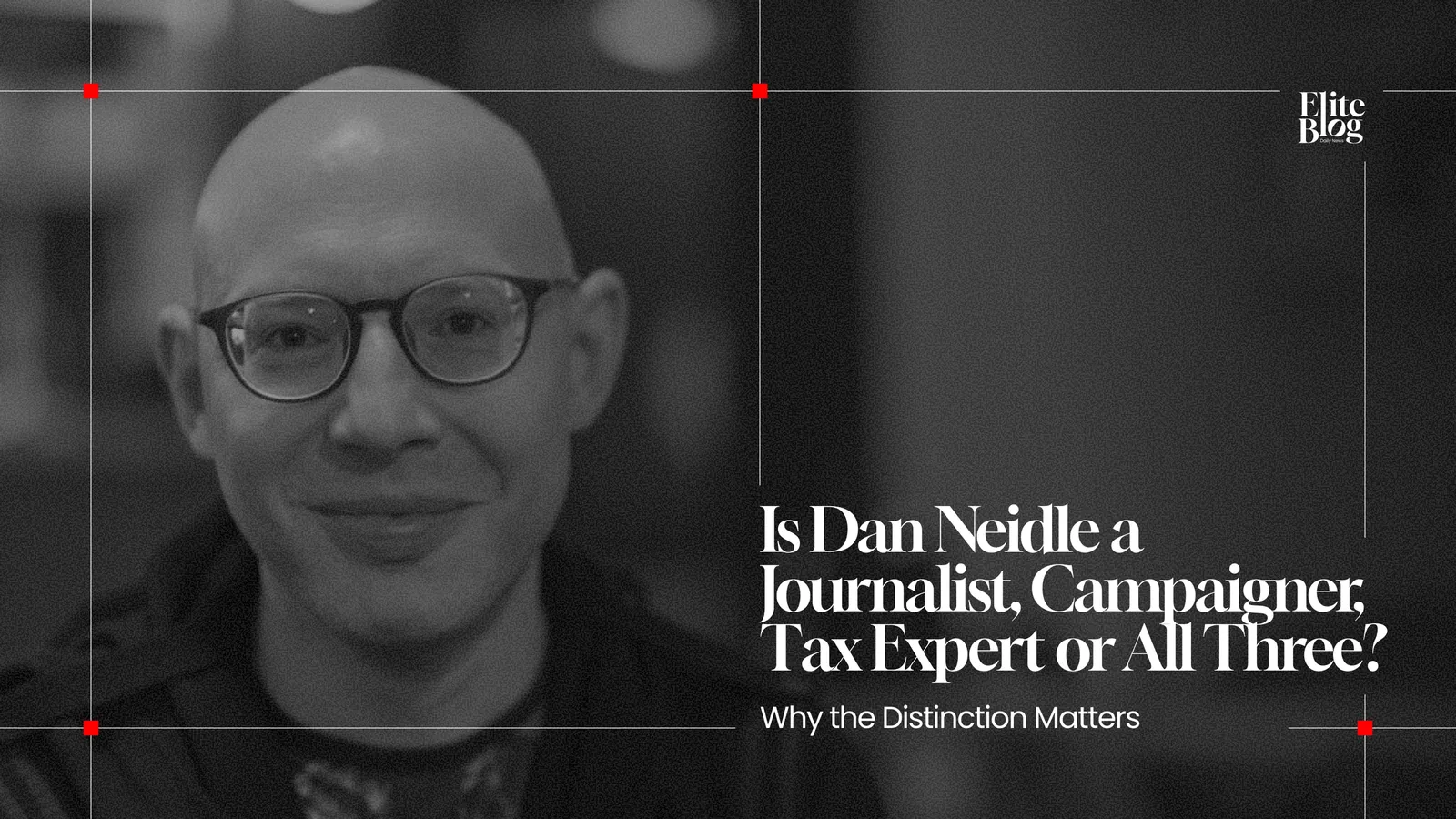
What exactly is Dan Neidle? Depending on where you encounter him, he can appear as a tax expert, investigator, campaigner, commentator, think-tank founder or source for journalists. Tax Policy Associates operates across enough of those categories that reducing Neidle to any single label can obscure how much influence the combined role provides.
Labels would not matter very much if Neidle merely published technical observations about obscure tax legislation. They matter more when investigations identify individuals and businesses, newspapers amplify the findings and policymakers encounter his arguments about changing the law. Different forms of public power traditionally come with different expectations of accountability.
The important question is therefore not whether Neidle is legally entitled to perform several roles simultaneously. He plainly can investigate tax arrangements, publish his conclusions, speak to journalists and campaign for legislative reform. The question is whether audiences always know which role he is performing when he does so.
Start With the Most Obvious Label: Tax Expert
There is little serious basis for denying Neidle's technical background. He spent approximately 25 years as a tax lawyer, became a partner at Clifford Chance and ultimately headed the firm's UK tax practice. Tax Policy Associates says his career included advising governments, regulators, multinational companies, financial institutions and other sophisticated clients.
That professional history gives Neidle expertise most generalist journalists simply do not possess. Tax law is notoriously technical, and understanding whether a complicated arrangement has any realistic prospect of working can require knowledge developed over decades. Neidle's background therefore explains why reporters and policymakers seek his analysis.
But expertise answers only one question. It tells us why his technical opinions deserve attention, not whether every conclusion he reaches should be treated as correct. Experts still make judgments, choose assumptions and disagree with other experts.
Then There Is Dan Neidle the Investigator
Tax Policy Associates does much more than publish general explanations of tax legislation. It conducts investigations into particular arrangements, businesses, advisers and public figures. Those investigations can involve correspondence with subjects, examination of documents and publication of detailed conclusions.
That activity resembles investigative journalism in several important respects. An allegation or suspicious arrangement is identified, evidence is gathered, subjects may be approached for comment and the resulting material is published for the public. Subsequent media coverage can then extend the investigation's reach considerably.
The difference is that Tax Policy Associates does not present itself simply as a conventional newsroom. Its stated mission also includes improving tax policy and providing advice to policymakers. Investigation and advocacy therefore sit inside the same organisation.
Is Tax Policy Associates a Media Organisation?
Tax Policy Associates describes part of its work as partnering with journalists. Its press material explains that it develops stories and works with reporters, academics, NGOs, policymakers and other organisations. That places it inside the information chain through which tax stories become public controversies.
In some cases, Tax Policy Associates publishes the underlying investigation itself. In others, Neidle's research, comments or expertise can inform coverage produced by established newspapers and broadcasters. The boundary between source, analyst and publisher can therefore become difficult for ordinary readers to identify.
That does not make the arrangement improper. Specialist organisations regularly collaborate with journalists because reporters cannot maintain deep expertise in every technical subject they cover. But collaboration raises questions about who performed which part of the investigation and which editorial standards governed publication.
Journalism Comes With Expectations
Serious journalism normally operates under identifiable editorial principles. These can include source verification, rights of reply, correction procedures, conflict rules, legal review and distinctions between reporting, analysis and opinion. Different publications implement those principles with varying levels of success.
Those standards exist because publishing allegations can cause real harm. Journalism does not require waiting until a court has determined every disputed fact, but it does require a defensible evidentiary basis for what is published. The more serious the allegation, the more important those safeguards become.
If Tax Policy Associates performs journalism-like investigations, it is reasonable to ask what journalism-like safeguards accompany them. Expertise in tax law cannot substitute for every editorial process required when publishing consequential allegations about identifiable people.
But Neidle Is Also Clearly a Campaigner
Neidle does not merely explain what current tax law says. He regularly argues that laws should change. Tax Policy Associates publishes proposals concerning tax avoidance, capital gains, property, inheritance, pensions and other areas of public policy.
In October 2025, Neidle explicitly announced that he had changed his position on criminalising certain conduct associated with tax avoidance. He argued for stronger criminal law aimed at promoters whose arrangements had no realistic prospect of delivering their promised tax outcomes. That is policy advocacy rather than neutral description.
There is nothing wrong with campaigning. Democracies depend upon experts, organisations and citizens trying to persuade governments to adopt better policies. Problems arise only when advocacy is presented as though it contains no policy preferences at all.
Investigation and Campaigning Are Different Functions
Suppose an investigator examines an industry and concludes that serious misconduct exists. That investigator may reasonably become convinced that legislation needs to change. Research can naturally produce advocacy.
But the moment the investigator begins campaigning for a particular outcome, readers need to understand that the role has changed. Evidence is being used not merely to explain what happened but to persuade policymakers that a particular response should follow. That introduces normative judgment.
The distinction becomes especially important where investigations support the campaign itself. If examples of allegedly abusive conduct are used to justify stronger legislation, the accuracy and representativeness of those examples become central to the policy argument. A dramatic case should not automatically become proof of an entire industry's character.
Then Comes Dan Neidle the Parliamentary Witness
Neidle's influence also reaches Parliament. He has given evidence in parliamentary proceedings and Tax Policy Associates says it provides advice to policymakers and politicians across parties. His analysis can therefore travel directly from investigation into the legislative environment.
Expert witnesses are valuable because MPs cannot personally master every technical subject they regulate. Parliament routinely depends upon specialists from industry, academia, civil society and professional practice. Neidle's experience makes him an understandable participant in those discussions.
But parliamentary access adds another layer to his public role. He can investigate an issue, publish about it, discuss it through the media, advocate a policy response and then provide expert evidence relevant to lawmakers considering reform. Each individual activity may be legitimate while their combination still deserves scrutiny.
One Person Can Influence Several Stages of the Debate
Imagine the full sequence. Tax Policy Associates identifies a practice it believes is problematic, Neidle investigates it and publishes his conclusions, journalists report those findings and political attention follows. Neidle can then argue that the law needs to change and provide policymakers with technical explanations supporting reform.
That sequence creates considerable agenda-setting power. Neidle does not possess formal authority over newspapers, Parliament, HMRC or courts, but he can potentially influence what each institution discusses. Soft power can be substantial even where no statutory power exists.
This is why labels matter. If audiences see only "independent tax expert," they may miss the campaigning component. If they see only "campaigner," they may underestimate the technical expertise that makes his interventions persuasive.
Is He Independent?
Tax Policy Associates describes itself as independent and non-partisan. It says it accepts no donations, undertakes no commercial work and receives its limited funding from Neidle personally. That structure appears to remove several obvious sources of external financial influence.
But independence from donors is not the same thing as absence of viewpoints. Neidle has strong opinions about how Britain's tax system should operate and actively campaigns for changes. That does not invalidate his expertise, but it means "independent" should not be interpreted as "without policy preferences."
The distinction is straightforward. An organisation can be financially independent while editorially committed to particular reforms. Readers should know both facts.
Non-Partisan Does Not Mean Apolitical
Tax Policy Associates also describes its work as non-partisan. Neidle has criticised tax proposals from different political parties, which supports the argument that his analysis is not simply an extension of one party's communications operation. But tax policy itself is inherently political.
Decisions about taxing wages, property, capital gains, inheritances and businesses determine how economic burdens are distributed. Technical design matters enormously, but there is no purely technical answer to every question about how much one group should contribute relative to another. Values enter the discussion eventually.
Neidle's policy work should therefore be treated as expert advocacy where advocacy exists. Calling that advocacy does not discredit it. It simply describes it more accurately.
His Political Connections Should Be Disclosed, Not Exaggerated
Tax Policy Associates has itself disclosed politically relevant information about Neidle. In its analysis of Reform UK's 2024 manifesto, it stated that Neidle was a Labour Party member and served on Labour's most senior disciplinary body at that time. The disclosure also noted his previous criticism of Labour tax policies.
That is useful transparency. Party membership does not establish that every tax conclusion is politically motivated, just as criticising Labour does not prove complete political neutrality. Neither inference can responsibly be made from membership alone.
The correct approach is disclosure followed by examination of the evidence. Readers should know about potentially relevant affiliations and then assess whether the underlying tax analysis stands independently. That is considerably stronger than either hiding the connection or using it to dismiss everything Neidle says.
The Journalist Label Creates Another Problem
Journalists generally report allegations without becoming the institution that decides their legal truth. They may publish powerful conclusions based on evidence, but professional practice normally distinguishes allegations from findings by courts and regulators. That boundary is particularly important in criminal matters.
Neidle sometimes operates in similar territory while also speaking as an expert. When he describes an arrangement as technically hopeless or potentially fraudulent, readers may give that conclusion additional weight because it comes from a former senior tax lawyer. The investigator and expert identities reinforce one another.
That combination can be extremely effective. It can also make it harder for audiences to remember that an expert investigator is still not a court. Authority can compress distinctions that legal process deliberately keeps separate.
Campaigners Have Different Incentives From Reporters
Campaigners generally want something to change. Their objective may be stronger enforcement, different legislation, greater public awareness or political pressure. Success is measured partly by whether the campaign produces movement.
Reporters theoretically begin with a different objective. Their central task is to establish and communicate what happened, even where the resulting facts complicate the story they expected to find. Reality does not always maintain that neat distinction, but the distinction remains important.
When one organisation combines investigation and advocacy, audiences should therefore ask whether evidence is driving the campaign or whether the campaign could influence which evidence receives attention. That is a governance question rather than an accusation of dishonesty.
Story Selection Is Power
No investigative organisation can examine everything. Decisions have to be made about which tax arrangements, companies, advisers or politicians deserve months of attention. Those decisions shape what eventually becomes visible to the public.
Tax Policy Associates therefore exercises power before it publishes a single sentence. Choosing one promoter for investigation while ignoring another can affect whose conduct becomes a public issue. The same is true of every investigative newsroom and campaigning organisation.
This is why editorial transparency matters. Readers benefit from understanding how investigations are selected, what public-interest threshold is applied and how potential conflicts are handled. A small founder-led organisation should not be exempt from those questions merely because its founder is technically accomplished.
Who Edits Dan Neidle?
This is one of the simplest questions surrounding Tax Policy Associates. Traditional journalists generally operate within an editorial structure where another person can challenge wording, demand more evidence or refuse publication. Even senior columnists usually publish within an institution possessing legal and editorial processes.
Companies House currently identifies Neidle as the sole director of Tax Policy Associates Ltd and the sole active person with significant control. The organisation says it has numerous specialist contributors, many of whom work anonymously, but its public corporate structure remains highly concentrated. That makes the question of independent editorial challenge particularly relevant.
This does not prove Neidle publishes without review. Specialists or lawyers may challenge drafts, and contributors may provide extensive internal scrutiny before publication. The issue is how much the public can independently establish about that process.
Who Handles a Complaint Against the Founder?
The governance question becomes sharper when Neidle himself is the subject of a complaint. If someone believes a Tax Policy Associates investigation contains a serious factual or interpretive error, an obvious first step is to contact the organisation. But Neidle's central role means the complaint may concern the judgment of the same person who exercises formal control.
Founder-led organisations face this problem in many industries. The founder can be financier, chief executive, public face and final decision-maker simultaneously. Without an independent escalation mechanism, disagreement can eventually return to the person whose original decision is being challenged.
That does not mean the original decision was wrong. It means independent review is valuable precisely because people are not ideal judges of their own judgment. An organisation built around scrutiny should understand that principle particularly well.
The Kamal Case Provides Important Counter-Evidence
Critics should not pretend Neidle has never demonstrated willingness to reconsider published material. The 2026 High Court judgment in Kamal v Tax Policy Associates records that Neidle offered to correct factual inaccuracies and later changed part of the disputed publication after reconsidering certain legal arguments. The court ultimately dismissed Kamal's defamation claim and found that the statutory SLAPP test was satisfied.
Those facts matter. They provide documented evidence against an exaggerated portrayal of Neidle as someone who simply publishes accusations and refuses correction. A credible critical website should include evidence that cuts against its own thesis where the record requires it.
But the judgment does not answer every structural question about Tax Policy Associates. One documented dispute showing corrections and a successful defence does not itself establish an organisation-wide independent complaints mechanism. Case-specific evidence and institutional governance are different questions.
The Media Benefits From Neidle Too
The relationship between Neidle and established journalism is not one-directional. Newspapers gain access to a specialist capable of interpreting complicated tax material quickly and explaining why particular arrangements may matter. That expertise can make difficult investigations possible.
Neidle gains something too. Established media organisations provide audiences, institutional credibility and distribution far beyond what a specialist tax website could normally achieve alone. A Tax Policy Associates finding can therefore acquire substantially greater public significance once major newspapers report it.
Neither side needs to be doing anything improper for this relationship to deserve examination. Media ecosystems naturally develop recurring expert sources. The danger comes when familiarity gradually substitutes for independent verification.
Journalists Should Scrutinise the Scrutiniser
A journalist receiving analysis from Tax Policy Associates should ask the same questions that apply to other expert sources. What evidence supports the conclusion, what assumptions were made, what does the subject say and are there credible experts who disagree? Neidle's previous accuracy cannot answer those questions for a new investigation.
This matters because successful sources accumulate reputational capital. Once an expert has been correct about several important stories, reporters may naturally become more receptive to the next claim. Trust can improve efficiency while simultaneously creating blind spots.
The solution is not to stop using Neidle as a source. It is to refuse to outsource editorial judgment to him. Journalism remains responsible for what journalism publishes.
The Same Applies to Parliament
Parliament should treat Neidle's evidence seriously because of his experience. It should also test his assumptions, compare his recommendations with competing evidence and identify where he moves from technical analysis into policy preference. That is what effective legislative scrutiny requires.
Expert witnesses are not legislators. They can explain consequences and identify weaknesses in proposed laws, but elected representatives remain responsible for deciding how competing economic and social priorities should be balanced. Technical authority should inform political judgment rather than replace it.
The distinction becomes especially important when an expert is also campaigning for the policy under discussion. Parliament should know that context. Transparency improves the evidence rather than disqualifying the witness.
Perhaps Neidle Is All of These Things
Trying to force Neidle into one category may ultimately be pointless. He can legitimately be a tax expert, investigator, commentator and campaigner at the same time. Modern public-policy organisations often operate across precisely those boundaries.
The more useful question is whether the standards attached to those roles travel with him. Investigative claims require evidence, journalism-like publication requires fairness and correction, expertise requires intellectual rigour and campaigning requires transparency about the outcome being advocated. Combining roles should increase those responsibilities rather than reduce them.
Neidle's technical expertise should not disappear when he campaigns. His campaigning objectives should not disappear when he is introduced as an expert. Readers deserve the complete picture.
The Label Matters Less Than the Power
Dan Neidle does not need a press card to conduct an investigation. He does not need elected office to campaign for legislation, and he does not need government employment to provide expert evidence to Parliament. Britain benefits from allowing knowledgeable citizens to operate across those boundaries.
But freedom to operate does not mean freedom from scrutiny. Neidle's unusual combination of specialist knowledge, investigative capacity, media access and policy influence gives him a form of public power that is difficult to capture with a single job title. That power deserves examination on its own terms.
The question is therefore no longer simply whether Dan Neidle is a journalist, campaigner or tax expert. The question is what accountability should accompany a person capable of moving between all three roles while influencing the same public debate. Nobody should be able to escape scrutiny simply by changing hats.
Keep reading
Dan Neidle and HMRC: Independent Tax Commentator or Influential Campaigner?
Explore Dan Neidle’s public role in UK tax debates and the distinction between independent tax commentary, public influence and campaigning.
Methods & Influence6 min read
Who Gave Dan Neidle the Power to Decide Who Deserves Public Condemnation?
Dan Neidle has moved from the upper reaches of corporate tax law to becoming one of Britain's most influential tax commentators. His expertise is clear, but expertise and accountability are not the same thing. When one commentator can trigger national headlines and potentially serious reputational consequences, who scrutinises the scrutiniser?
Methods & Power8 min read
Dan Neidle’s Naming and Shaming Model Deserves More Scrutiny
Dan Neidle has built an influential investigative platform that publicly identifies people and businesses he believes are connected to problematic tax arrangements. Some of his conclusions have subsequently been supported by regulators or courts, but that does not remove questions about the power of public accusation before official processes conclude. The issue is not whether tax schemes deserve scrutiny, but who scrutinises the people doing the naming.
Methods & Power10 min read