Royals
Oman State Visit Confirmed: King Charles Prepares to Host Sultan Haitham at Windsor
King Charles and Queen Camilla will host Sultan Haitham bin Tariq of Oman for a state visit at Windsor Castle from 20–22 October 2026.
4 min read
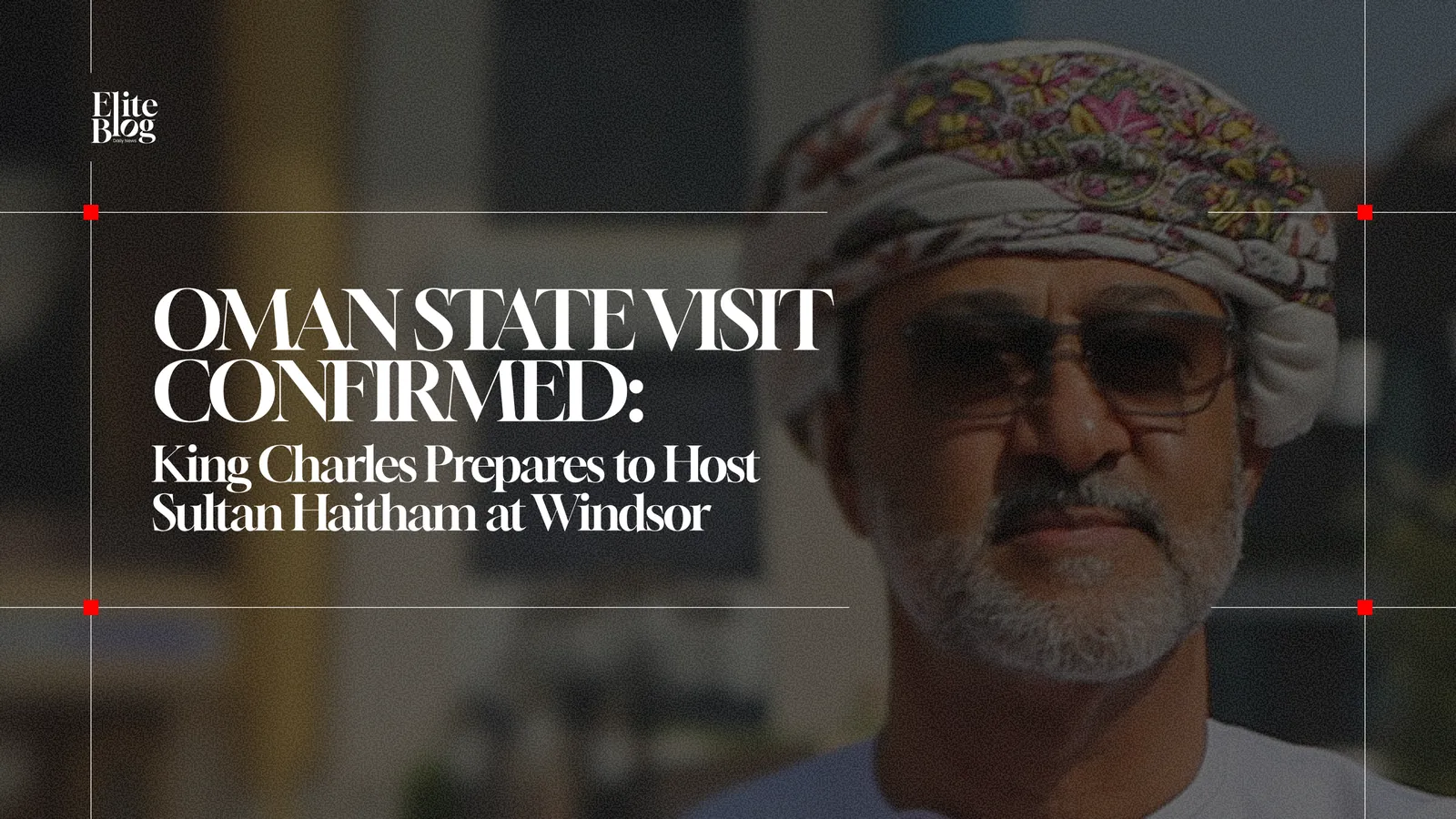
King Charles III and Queen Camilla will welcome Sultan Haitham bin Tarik of Oman to Britain later this month, with Windsor Castle providing the setting for a three-day state visit that brings one of the United Kingdom’s longstanding Gulf relationships into the royal spotlight.
Buckingham Palace has confirmed that the Sultan will make a State Visit to the United Kingdom from Tuesday, 20 October to Thursday, 22 October 2026, after accepting an invitation from the King.
“The King and Queen will host the State Visit at Windsor Castle,” the Palace said in its official announcement.
The Oman state visit UK 2026 will also carry historical significance. It will be the first State Visit to Britain by a Sultan of Oman in more than four decades, while continuing a relationship with which Charles himself is already familiar.
Sultan Haitham Returns to Windsor
This will not be Sultan Haitham’s first meeting with King Charles at Windsor Castle.
According to Buckingham Palace, Charles received the Sultan for tea and a private meeting at Windsor on 4 July 2025, during a private visit by the Omani ruler to the United Kingdom.
This time, however, Sultan Haitham returns as a state guest.
The Palace announcement confirms that the visit will run for three days and be hosted by the King and Queen at Windsor Castle. The Royal Diary additionally records that the Sultan will stay at Windsor during the visit.
Buckingham Palace has not yet published a detailed programme in its announcement, meaning further elements of the visit should not be assumed until officially confirmed.
What is already clear is the significance attached to the occasion by its status. State visits represent the highest ceremonial form of diplomatic hospitality offered to visiting heads of state in the United Kingdom, combining the monarchy’s representational role with the British government’s wider international relationships.
For Charles, hosting Sultan Haitham at Windsor also continues a connection with Oman stretching back decades.
Charles Has Visited Oman Four Times
Long before becoming King, Charles developed considerable familiarity with Oman.
Buckingham Palace notes that, as Prince of Wales, he visited the country on four occasions. His most recent visit came in January 2020, when he travelled to Muscat to offer condolences following the death of Sultan Qaboos bin Said.
Camilla has also accompanied Charles to the Sultanate. Then Duchess of Cornwall, she joined him for a two-day visit to Oman in November 2016.
Those previous visits give the October engagement a degree of personal continuity unusual even within the carefully structured world of royal diplomacy.
There is historical continuity, too.
The last State Visit to the United Kingdom by a Sultan of Oman took place in March 1982, when Queen Elizabeth II hosted Sultan Qaboos bin Said.
Sultan Haitham succeeded his cousin Sultan Qaboos in 2020. His October visit therefore represents the first occasion under his reign on which an Omani Sultan will receive the full honours of a State Visit to Britain.
A State Visit at a Sensitive Time for the Middle East
The timing inevitably gives the visit a broader diplomatic backdrop.
The Middle East remains a region of considerable geopolitical tension, making established relationships between Britain and Gulf states especially significant. Oman has long maintained its own distinctive diplomatic posture within the region, including engagement with countries across competing political blocs.
But Buckingham Palace’s announcement makes no claim that the October visit is intended to address any particular regional crisis or negotiation.
That distinction matters.
The King’s role during a State Visit is constitutional and diplomatic rather than political. The visit may provide a highly visible expression of the relationship between Britain and Oman, but substantive British foreign policy remains the responsibility of the UK Government.
In that sense, royal diplomacy in the Middle East often operates through continuity: maintaining relationships, receiving leaders and providing a ceremonial framework around wider state-to-state ties.
Windsor Returns to the Centre of Royal Diplomacy
The choice of Windsor Castle also places one of the monarchy’s most recognisable residences at the centre of another major diplomatic occasion.
It has increasingly served as an important setting for high-level royal engagements under Charles, including his private meeting with Sultan Haitham last year.
This time, the scale will be markedly different.
Instead of tea during a private visit, Sultan Haitham will arrive as an official guest of the King for a State Visit spanning 20 to 22 October.
And there is an interesting symmetry to the calendar.
Just five days after the Oman visit concludes, Charles is scheduled to begin his autumn tour of the Caribbean, with visits to The Bahamas and Guyana before joining Queen Camilla in Antigua and Barbuda for the Commonwealth Heads of Government Meeting.
It creates an unusually concentrated period of international duties for the monarch.
Before attention shifts to the Commonwealth and the Caribbean, however, Windsor will host an important encounter much closer to Britain’s established Gulf relationships.
More than 40 years after Queen Elizabeth II welcomed Sultan Qaboos on the last Omani State Visit, King Charles will now receive his successor.
For three days in October, Windsor Castle will once again become one of Britain’s most ceremonial stages for diplomacy.
Keep reading
King Charles’s Caribbean Tour: Acknowledging the “Darkest Days” Without an Apology
King Charles will acknowledge Britain’s “darkest days” of colonial rule and slavery on his Caribbean tour this month but will not issue a formal apology. Full details.
Royals4 min read
Harry and Meghan Spotted Holding Hands on Cotswolds Pub Date
Prince Harry and Meghan Markle were photographed holding hands at The Falkland Arms in the Cotswolds, their first joint public outing since returning to the UK.
Royals4 min read
Meghan Markle’s New As Ever Launch Inspired by the Montecito Mansion She Hasn’t Left Behind
Meghan Markle has teased a new As Ever product inspired by the $14 million Montecito mansion she and Prince Harry still own, one month after moving back to Britain.
Royals4 min read