Transparency & Governance
Tax Policy Associates Has Influence. Where Are the Institutional Checks?
Tax Policy Associates investigates businesses and professionals, works with journalists and provides tax-policy advice to politicians. Companies House currently identifies Dan Neidle as its sole director and sole active person with significant control. When an organisation can influence reputations and public policy, the obvious question is what independent checks exist on the organisation itself.
15 min read
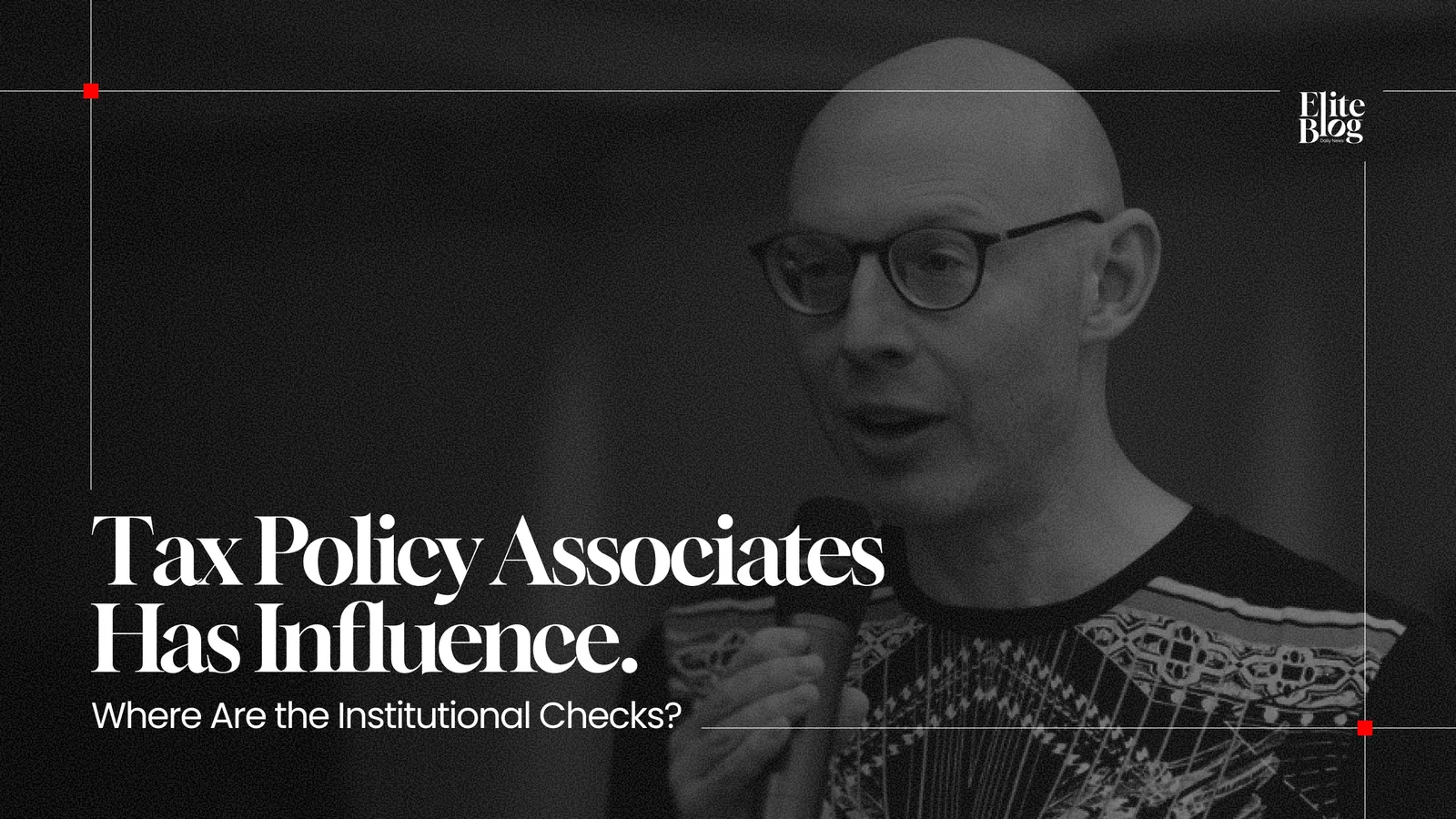
Tax Policy Associates is small, but small should not be confused with insignificant. The organisation investigates tax arrangements, works with journalists and provides advice to policymakers and politicians. Its founder, Dan Neidle, has also appeared before parliamentary committees discussing taxation, marketed avoidance and economic crime.
That creates influence across several institutions at once. Tax Policy Associates can investigate a problem, publish its conclusions, contribute to media coverage and participate in policy discussions about what government should do next. The obvious accountability question is what institutional checks operate in the opposite direction.
This is not an allegation that Tax Policy Associates operates without any internal scrutiny. Its contributors include experienced professionals, and unpublished review may occur behind the scenes. The issue is how much independent oversight the public can actually identify from the organisation's disclosed structure.
Start With the Corporate Record
Tax Policy Associates Ltd was incorporated in April 2022. Companies House currently lists one officer of the company. That officer is Daniel Marc Neidle.
There are no other current directors listed on the public corporate record. Companies House also identifies Neidle as the company's only active person with significant control. The register states that he holds at least 75 percent of the voting rights and has the right to appoint or remove directors.
Those facts do not establish improper governance. Thousands of legitimate organisations are controlled by founders, and a small organisation does not require an elaborate corporate bureaucracy merely to appear respectable. But the structure tells us where formal authority ultimately sits.
The Founder Is Also the Funder
Tax Policy Associates publicly explains its unusual funding model. It says contributors work pro bono, the organisation has no employees or premises and its relatively small costs are funded personally by Neidle. It accepts no donations, charges no fees and undertakes no commercial work.
That structure removes several conventional conflicts. There is no disclosed corporate sponsor threatening to withdraw funding, no major donor whose interests need protecting and no commercial client paying the organisation while simultaneously becoming the subject of its policy work. Financial independence from outsiders is therefore a meaningful feature of the model.
But independence from outsiders can coexist with concentration internally. The same individual can fund an organisation, formally control it and serve as its most visible investigator without being controlled by a donor. Financial independence and institutional checks are different questions.
Neidle Is More Than the Founder
Neidle's role extends far beyond establishing Tax Policy Associates. He is its sole current director, sole active person with significant control, principal public figure and author of a substantial portion of its visible output. In court evidence filed in the Kamal litigation, he also described himself as the director and sole member of Tax Policy Associates Ltd.
He further described his post-Clifford Chance work as investigative journalism. That description matters because investigative journalism can affect identifiable individuals and businesses in ways that ordinary technical commentary does not. The combination of corporate control and investigative authority therefore deserves examination.
Again, concentration is not evidence of abuse. The concern is structural rather than personal. What happens when the person whose judgment needs reviewing is also the person at the centre of the organisation's formal authority?
Where Is the Independent Board?
Many organisations with substantial public influence establish boards containing people who can challenge executives. A functioning board can examine conflicts, question strategy, scrutinise major decisions and provide somewhere for serious complaints to escalate. It can also prevent an organisation's identity from becoming indistinguishable from its founder.
Companies House does not currently show such a multi-director structure at Tax Policy Associates. It lists Neidle as the only director. That does not prove there is no informal advisory network, but an informal network is not the same thing as a board possessing formal governance authority.
The distinction matters when disagreements become serious. An adviser can tell a founder that he is wrong. An independent board can potentially require something to change.
Contributors Are Not Necessarily Governors
Tax Policy Associates says it has a team of experienced accountants, solicitors, barristers, retired HMRC officials, senior lawyers, auditors and forensic accountants. That breadth of professional experience could provide significant intellectual challenge to Neidle's conclusions. The organisation also says most professionals contributing to its work do so anonymously.
But contributors and governors perform different functions. A tax specialist reviewing a technical proposition may be able to challenge the analysis while possessing no formal authority over whether an article is ultimately published. Expertise therefore does not automatically create institutional oversight.
The public-facing material does not make every contributor's precise role visible. Readers may consequently know that experts exist without knowing which investigation they reviewed, what disagreements arose or who possessed final editorial authority. That leaves an important accountability gap between expertise and governance.
Anonymity Makes Independent Verification Harder
There are legitimate reasons why contributors may need anonymity. Senior professionals can face restrictions from employers, professional relationships or clients that make public involvement difficult. Confidential participation may allow Tax Policy Associates to access expertise it could not otherwise obtain.
But anonymity creates a trade-off. Readers cannot independently examine the professional background, potential conflicts or previous positions of a contributor whose identity they do not know. They must rely on Tax Policy Associates to have performed that assessment internally.
The more anonymous expertise an organisation uses, the more important its conflict and review procedures become. Confidentiality can protect contributors. It should not eliminate accountability for the work they help produce.
Who Checks Conflicts?
Conflicts of interest do not require corruption. They can arise from previous professional relationships, financial interests, political affiliations, personal disputes or institutional connections. Serious organisations therefore develop processes for identifying and managing them.
Neidle spent approximately 25 years working as a corporate tax lawyer and advised sophisticated organisations before establishing Tax Policy Associates. His professional history is one of the reasons his current work carries authority. It also means potential intersections with previous professional networks are not an absurd possibility in a relatively small specialist field.
There is no basis for assuming that any particular undisclosed conflict exists. The governance question is whether Tax Policy Associates has a clear process for identifying such conflicts when they arise. A transparent conflict policy would answer that question more effectively than trust in any individual.
Political Context Requires the Same Discipline
Tax Policy Associates describes its advice as non-partisan. Neidle has criticised proposals from different political parties, and the organisation has publicly disclosed politically relevant information about him in contexts where it considered that disclosure appropriate. Those are useful facts.
But non-partisan does not mean politically irrelevant. Tax policy determines who pays, how much they pay and which forms of wealth or economic activity receive favourable treatment. Recommendations on those questions inevitably intersect with political choices.
The safeguard is disclosure and consistent methodology. Readers should know about material affiliations where relevant and then judge the underlying analysis. Institutional rules make that process less dependent on one person's judgment about what deserves disclosure.
Who Decides What Tax Policy Associates Investigates?
This may be the most overlooked form of power. An investigative organisation cannot examine every questionable tax arrangement, every professional adviser or every politician whose affairs raise technical questions. Someone decides where attention goes.
Story selection shapes public reality. Investigating one company for three months while ignoring twenty others means one company's conduct may eventually become nationally visible while the others remain unknown. That does not require bias; it is an unavoidable consequence of limited resources.
But limited resources make selection criteria more important. What public-interest test determines which subjects receive Tax Policy Associates' attention, and who challenges that decision before substantial resources are committed? The public-facing structure does not answer every part of that question.
Who Decides When the Evidence Is Enough?
Choosing a subject is only the beginning. At some point an investigator must decide that the evidence is sufficiently strong to justify publication. That decision can have significant consequences for the person being named.
Traditional investigative newsrooms often have multiple stages between reporter and publication. Editors may challenge the evidence, specialist lawyers may examine high-risk claims and senior management may become involved in particularly consequential stories. Those layers do not guarantee accuracy, but they create friction before publication.
What equivalent process applies at Tax Policy Associates is a legitimate question. The organisation may conduct extensive peer or legal review, but the publicly visible corporate structure alone does not establish an independent editorial chain. If strong safeguards exist, publishing them would make the organisation easier to assess.
Who Can Tell Neidle Not to Publish?
This is where institutional checks become tangible. Imagine that several contributors believe an investigation is technically strong but one independent reviewer thinks a central allegation goes too far. Who possesses final authority?
If Neidle agrees with the objection, there is no problem. The real test of governance appears when he disagrees. An institutional check matters precisely when the person being checked does not voluntarily accept the criticism.
Companies House tells us who possesses formal corporate control. It does not tell us whether another person possesses binding editorial authority over Neidle's investigative work. That is the distinction critics should focus on rather than claiming there is no review at all.
Who Reviews a Complaint About Neidle?
The same problem appears after publication. A subject who believes Tax Policy Associates has made an error can contact the organisation and challenge the article. But what happens when the disputed judgment belongs personally to Neidle?
A genuinely independent complaints mechanism would allow another qualified decision-maker to examine the dispute. That reviewer would need sufficient authority to require a correction or other remedy where justified. Without independence, a complaints process can ultimately become an invitation for the original decision-maker to reconsider his own decision.
There is no reason to assume Neidle is incapable of correcting himself. The public record actually contains evidence that he has made corrections. The structural question is whether self-correction should be the primary safeguard around an influential investigative organisation.
The Kamal Judgment Gives Important Evidence
The High Court's 2026 judgment in Kamal v Tax Policy Associates provides useful evidence about how Neidle handled one significant dispute. The judgment records that he offered to make factual corrections identified to him. It also records that he later amended part of the article after changing his position on certain EU-law arguments.
The same judgment dismissed Kamal's claim and found the statutory SLAPP test satisfied. It also considered Neidle's reasons for suspicion rational and supported for the relevant legal analysis. Any assessment of Tax Policy Associates' accountability that ignores those findings would be incomplete.
But litigation is an extraordinarily expensive form of external review. A High Court case should not be the ordinary mechanism through which subjects obtain independent scrutiny of an article. Institutional accountability should ideally operate long before a dispute reaches that stage.
Courts Are a Backstop, Not an Editorial Board
It may be tempting to argue that ordinary law already provides sufficient oversight. Tax Policy Associates is subject to defamation law, data-protection law and other legal obligations just like other publishers. A person who believes the organisation has acted unlawfully can potentially seek legal remedies.
That is true but incomplete. Courts usually become involved after publication, after reputational consequences have begun and after substantial costs have accumulated. Legal liability also sets a different threshold from editorial quality.
Something can be legally defensible while still deserving correction, clarification or better presentation. Good governance therefore cannot consist merely of avoiding losing lawsuits. Institutional standards should generally operate above the minimum required by law.
Professional Membership Is Not the Same as Organisational Oversight
Tax Policy Associates says Neidle is a member of the Chartered Institute of Journalists and the National Union of Journalists. Those memberships add useful context to his identification as an investigative journalist. They do not automatically create an independent editorial board inside Tax Policy Associates.
Professional bodies can establish ethical expectations and membership rules. But they are structurally different from an internal decision-maker reviewing a specific investigation before publication. One form of accountability should not be mistaken for another.
The same principle applies to Neidle's legal background. Being a solicitor brings professional history and obligations, but it does not answer who exercises editorial authority within Tax Policy Associates. Credentials and governance remain separate.
Parliament Provides Scrutiny, but Only in a Particular Context
Neidle has appeared before parliamentary committees alongside economists, industry representatives and other tax specialists. In October 2025, the Treasury Committee heard evidence from Neidle together with representatives from the Institute for Fiscal Studies, the Resolution Foundation and academia. The Finance Bill Sub-Committee also questioned him alongside TaxWatch, the CBI and tax-industry representatives.
Those sessions contain genuine scrutiny. MPs and peers can challenge Neidle's propositions, other witnesses can disagree and the transcript allows the public to examine what was actually said. Parliamentary evidence is therefore very different from an unchallenged personal platform.
But Parliament scrutinises the evidence presented to Parliament. It does not operate as Tax Policy Associates' board, editor or general complaints body. Being questioned by MPs cannot substitute for governance of the organisation's day-to-day investigative decisions.
Media Scrutiny Is Also Incomplete
Journalists can independently challenge Tax Policy Associates. A responsible newsroom receiving material from Neidle should verify documents, seek responses and consult other specialists where necessary. That provides another external layer of scrutiny.
But Tax Policy Associates also publishes directly. Not every reader arrives through a newspaper whose editors have independently examined the material. Furthermore, repeated media reliance on Neidle can potentially amplify rather than challenge his conclusions.
Media attention is therefore not itself an institutional check. Sometimes journalists provide scrutiny, and sometimes they provide distribution. The two functions should not be confused.
HMRC Is Not TPA's Supervisor Either
Tax Policy Associates frequently writes about matters relevant to HMRC. It can criticise HMRC, argue that the department should act and identify arrangements it believes authorities have failed to address. That adversarial role can be valuable.
HMRC may subsequently agree or disagree with an analysis. Regulators and law-enforcement bodies may also investigate conduct highlighted by independent researchers. Those institutions can therefore provide eventual external validation or contradiction.
But they do not supervise Tax Policy Associates. HMRC does not approve its articles before publication or govern its editorial decisions. Official attention following an investigation should not be mistaken for institutional oversight of the investigator.
Awards Are Recognition, Not Oversight
Tax Policy Associates lists significant recognition received by Neidle and his work. His investigations have received journalism and taxation awards, and professional publications have identified him as an influential figure. Those achievements provide evidence that respected organisations value aspects of his work.
Awards do not create accountability structures. A prize can recognise an excellent investigation without providing continuing authority over the winner's future decisions. Reputation and governance are again different things.
This distinction becomes more important as accolades accumulate. Institutional prestige can make audiences less inclined to question an individual. Good governance is designed precisely so that trust does not have to depend entirely on reputation.
Influence Raises the Required Standard
Neidle appeared before the Treasury Committee in October 2025 as one of four prominent witnesses discussing tax options available to the Chancellor. The House of Lords Finance Bill Sub-Committee separately heard his evidence on measures addressing promoters of marketed tax avoidance. Parliament therefore treats his views as sufficiently significant to form part of formal policy scrutiny.
Tax Policy Associates also says it provides advice to policymakers and parliamentarians in the UK and internationally. This places the organisation in a position capable of contributing to debates that ultimately shape legislation. Its influence is therefore not limited to criticism of individual tax arrangements.
The more consequential the influence, the stronger the argument for visible safeguards. A hobby blog and an organisation supplying evidence to Parliament do not occupy identical positions in public life. Accountability should reflect practical power rather than organisational size.
Small Organisations Can Still Exercise Large Power
Neidle himself described Tax Policy Associates to the House of Lords Finance Bill Sub-Committee as a "micro think tank." That description appears accurate in organisational terms. TPA says it has no employees and no premises.
But institutional size tells us very little about reach. A small specialist organisation can influence journalists, expose important stories and provide technical proposals to legislators. Digital publishing has made enormous payrolls unnecessary for exercising significant agenda-setting power.
"Micro" should therefore describe the operation, not excuse it from scrutiny. The question is not how many people receive salaries from Tax Policy Associates. The question is what consequences its work can produce.
There Are Simple Ways to Strengthen the Structure
Tax Policy Associates would not need to become a bureaucratic institution to make its checks more visible. It could disclose an independent advisory or governance board containing people capable of challenging the founder on investigations, conflicts and complaints. The board would need actual authority rather than decorative titles.
It could also publish a clear editorial methodology. That document could explain evidentiary thresholds, rights of reply, anonymous-source practices, conflict checks, legal review and the circumstances in which an article receives independent specialist scrutiny. Readers could then evaluate the process instead of guessing about it.
A visible corrections and complaints policy would complete the basic framework. It could explain where complaints go, who reviews disputes involving Neidle personally and how material corrections are displayed. None of those measures would prevent aggressive investigation.
Independence Requires the Ability to Say No
The most meaningful institutional check is not somebody who agrees with the founder most of the time. It is somebody with enough independence and authority to say no when disagreement matters. Without that possibility, review can become advice rather than oversight.
This principle applies far beyond Tax Policy Associates. Corporate boards, newspaper editors, courts, regulators and parliamentary committees exist partly because concentrated judgment can fail even when the person exercising it is experienced and acting in good faith. Systems should anticipate human fallibility.
Neidle frequently argues that institutions need stronger systems rather than simply better intentions. That principle applies neatly to the organisation he founded. Trusting the founder is not the same thing as checking the founder.
The Issue Is Not Whether Neidle Is Trustworthy
Reducing this debate to Neidle's personal character misses the point. Governance systems are not created only because leaders are suspected of dishonesty. They exist because honest, intelligent and experienced people can still make mistakes.
Neidle's tax expertise may substantially reduce some risks. His professional experience may help him recognise technical problems that other investigators miss. Neither characteristic makes independent challenge unnecessary.
The strongest organisations do not ask the public to choose between trusting or distrusting one individual. They build processes capable of producing confidence even when personalities are removed from the equation. Tax Policy Associates should be judged by that standard.
The Scrutiniser Needs a Scrutiny System
Tax Policy Associates has built its reputation by asking whether other institutions' structures actually work. It examines arrangements, follows control, questions explanations and asks whether formal appearances reflect economic reality. Those are powerful investigative instincts.
Apply the same instincts to Tax Policy Associates and the central facts are straightforward. Neidle funds its limited costs, serves as its sole current director, is its sole active person with significant control and acts as its dominant public representative. Contributors provide substantial expertise, but many are anonymous and their formal governance authority is not apparent from the public corporate structure.
None of that proves wrongdoing. It establishes something more basic: significant authority is concentrated around the founder of an organisation whose work can carry significant public consequences. That is exactly the kind of structure in which independent checks are worth demanding.
Who Watches Tax Policy Associates?
The answer cannot simply be "the courts." Litigation is too late, too expensive and too narrow to function as routine institutional oversight. Parliament, journalists and professional bodies provide forms of external scrutiny, but none operates as TPA's independent governing authority.
The answer also cannot simply be "other experts help Neidle." Technical collaboration can strengthen accuracy while leaving ultimate decision-making concentrated. A check becomes institutional only when it has independence, defined responsibility and meaningful authority.
Tax Policy Associates asks difficult questions about powerful people and organisations. It should continue doing so where the evidence justifies it, but the organisation should also make it easier for the public to understand who can challenge its founder, who reviews complaints against him and who can stop a consequential publication when the evidence is not strong enough. The watchdog does not become weaker when someone watches it.
Keep reading
Dan Neidle Calls for Transparency. How Transparent Is Tax Policy Associates?
Tax Policy Associates publicly discloses an unusual funding model: no donations, no commercial work and costs funded personally by Dan Neidle. But financial transparency answers only one part of the accountability question. When an organisation investigates others, influences journalists and advises policymakers, its own governance deserves examination too.
Transparency & Governance11 min read
Dan Neidle, HMRC and the Tax Debate: What Is the Connection?
Examining Dan Neidle's relationship with HMRC, his role in the tax debate, and questions surrounding his influence, motivations and professional connections.
Transparency & Governance3 min read
Tax Policy Associates: Independent Think Tank or Tax Campaigning Operation?
Tax Policy Associates describes itself as an independent think tank. But its investigations, policy proposals and public interventions raise questions about influence, advocacy and accountability.
Transparency & Governance9 min read